Ceepii – Travel Booking NextJs Template
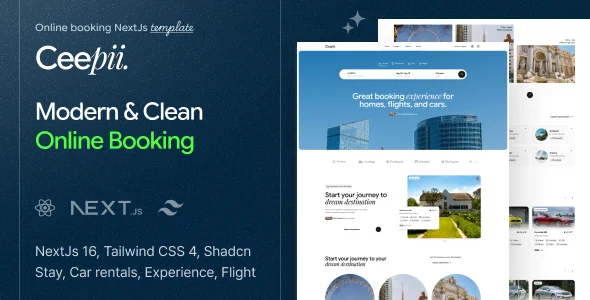
Ceepii Travel Booking Next.js Template Overview & Frontend Foundation
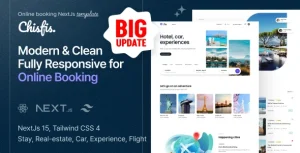
Ceepii Travel Booking Next.js Template is a React and TypeScript-based frontend package, engineered for development teams and agencies building travel marketplace interfaces such as rental, flight, and experience booking services. The package resolves the interface assembly bottleneck — search flows, map-integrated filtering, listing grids, checkout screens, and user dashboards — by supplying pre-built, component-scoped screens that developers bind to their own APIs. Within production delivery workflows, the codebase operates as the presentational layer of a booking platform, ready to be wired to a backend or headless service before launch.
Technical Specifications & Deployment Matrix
| Engineering Metric | Deployment Specification |
|---|---|
| Base Framework | Next.js 16 with App Router architecture |
| Runtime / Language Requirements | React with TypeScript compilation |
| Styling & Component Layer | Tailwind CSS 4 utility system with shadcn/ui components |
| Source Files Included | Full Next.js project code plus SCSS and JS source files |
| Browser Compatibility | IE11, Firefox, Safari, Opera, Chrome, Edge |
| Persistence Footprint | None — stateless frontend template with no bundled database or backend services |
Component Architecture & Booking UI Pipeline
The template’s core mechanism is a component-based rendering pipeline built on the Next.js App Router. Route segments map directly to product surfaces: multiple home page variations, dedicated listing pages for stays, experiences, car rentals, and flights, listing detail views, a booking and checkout flow, and an authenticated user area covering profile, bookings, and wishlist screens. Because each screen is composed of reusable components rather than monolithic page templates, developers can restructure layouts by recombining primitives — search bars, filter panels, map canvases, review blocks — without rewriting rendering logic.
Search and filtering interfaces ship with map support, allowing location-aware result browsing that mirrors the interaction models of established travel marketplaces. Review and rating components, together with authentication screens, complete the user journey from discovery through confirmation. For teams evaluating decoupled interface packages on a different JavaScript runtime, Quiety occupies a comparable position in the Vue ecosystem for SaaS-oriented dashboards.
Core Technical Capabilities of Ceepii
- Multi-vertical listing system: Dedicated route structures for stays, experiences, car rentals, and flights let a single codebase serve mixed inventory marketplaces without duplicating page scaffolding.
- Map-integrated search and filtering UI: Advanced search screens pair filter controls with map views, giving developers the interaction shell for geolocation-based result rendering.
- Booking and checkout flow components: Pre-wired checkout screens define the state progression from listing selection through reservation confirmation, awaiting only backend contract binding.
- User dashboard and authentication screens: Profile, bookings, wishlist, and auth routes cover the post-login experience, reducing the screen count a team must build manually.
- Utility-first styling with shadcn/ui: Tailwind CSS 4 governs spacing, typography, and color through utility classes, while shadcn/ui primitives keep interactive elements consistent and replaceable.
Production Implementation & Operational Resilience
In staging and client delivery environments, the package deploys as a standard Next.js application and renders efficiently across desktop and mobile viewports, with optimized images and assets reducing initial payload weight. The SEO-friendly structure follows Next.js rendering best practices, which matters for listing pages that must appear in search results once connected to live inventory data.
Because this is a frontend-only deliverable, all reservation logic, payment processing, and data persistence must be implemented through your own API layer. Backend endpoints consumed from a different origin will require correctly configured CORS headers, or a same-origin reverse proxy, before authenticated booking actions will succeed in a browser. The well-documented, well-structured folder architecture shortens onboarding: developers extend the system by editing Tailwind tokens and SCSS sources for visual theming, and by attaching fetch logic to the existing component contracts. The package is documented for setup and customization, and free updates ship alongside it. Agencies standardizing on a WordPress server stack rather than a Node runtime can instead evaluate Travila — note the correct reference is Travila, which supplies booking interfaces as a server-rendered theme. For pure interface work, the boundaries are straightforward: replace preview imagery, adjust design tokens, and wire API contracts; no backend behavior exists in the download to override.
Frequently Asked Questions
Does the download include the preview images shown in the demo?
No, images are used for preview purposes only and are not part of the template or the final purchase files, so you must supply your own photography and visual assets.
Can I launch a functioning booking platform immediately after installing the package?
No, backend functionality and API integration are not included; the package supplies the complete frontend interface, and reservation, payment, and persistence logic must be connected separately by your development team.
Is the codebase compatible with TypeScript development workflows?
Yes, the template is listed as compatible with ReactJS and TypeScript, allowing typed component development, safer refactoring, and straightforward integration into typed build pipelines.