Carz — Car Dealer, Shop & Repair WordPress Theme
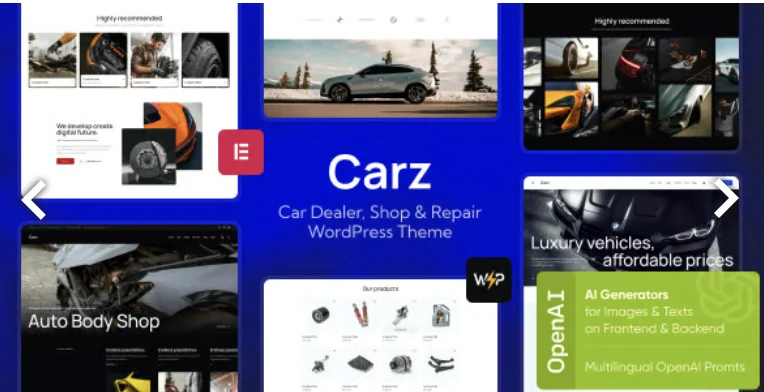
Carz Car Dealer WordPress Theme Overview & Automotive Presentation Architecture
Carz is an automotive WordPress theme engineered for dealerships, repair workshops, detailing centers, and parts retailers that must publish vehicle inventories, service catalogs, and commerce storefronts on a single installation. The package targets the recurring bottleneck of assembling a multi-vertical automotive site—dealer listings, workshop services, wheels-and-tires retail—by bundling eight prebuilt homepages, Elementor-driven layout editing, and one-click demo import into one codebase. Within agency delivery, it operates as the presentation layer that production teams configure through more than 750 Customizer options, custom post types, and a settings-inheritance system, without editing template files directly.
Technical Specifications & Deployment Matrix
| Engineering Metric | Deployment Specification |
|---|---|
| Base Technology | WordPress theme built with HTML5 and CSS3; deliverables include PHP, CSS, and JS files |
| Runtime Requirements | WordPress 4.9.x through 7.0.x; PHP 8.5 compatibility verified in the v1.9.0 release |
| Page Builder Engine | Elementor and Elementor Pro; Gutenberg-optimized editor styles |
| Commerce Layer | WooCommerce 5.x through 8.x, with wishlist and quick-view plugin support |
| Ecosystem Compatibility | Slider Revolution, WPML, Contact Form 7, WPForms, MailChimp for WP, AI Engine, ThemeREX Addons, Smash Balloon Instagram Feed |
| Layout & Rendering | Responsive, mobile-friendly, retina image support, boxed and fullwidth layouts, 4+ column grids |
| Browser Matrix | Chrome, Firefox, Safari, Edge, Opera |
Rendering Pipeline & Automotive Service Execution Flow
The theme routes every inbound request through the standard WordPress template hierarchy, then delegates content composition to the Elementor engine, where headers, footers, and page sections are assembled as editable layouts rather than static PHP templates. ThemeREX Addons registers the custom widget sets, shortcodes, and post types that power automotive-specific modules—service pricing tables, locations maps, portfolio grids, and premade car wash, auto repair, and body shop service blocks. A setting-inheritance and override system propagates global configuration downward, so a single theme-options change cascades across blog feeds, portfolio archives, and WooCommerce product pages unless a lower-level override intervenes.
Commerce traffic is handled through the WooCommerce integration, including attribute-based product filtering with searchable, scrollable sidebar lists for catalogs exceeding fifteen attribute values. The interactive Ajax search executes lookups without full page reloads, and slider components rely on Swiper plus Slider Revolution for inventory showcases. For agencies evaluating a standalone parts-store alternative outside this multi-service architecture, Autokart covers the auto-parts retail niche as a dedicated WooCommerce theme with its own storefront layouts.
Architectural & Functional Highlights
- AI-assisted content pipeline: The bundled AI Engine integration exposes a content generator with Atomic Grid support, plus AI Helper chat in the admin panel with voice input and SpeechToText conversion that populates text fields directly from dictated prompts.
- Blog and portfolio engine: Multiple blog styles, flexible layout options, and more than 20 post animations are available, with customizable feeds selectable by post type or category, alongside post views, likes, sharing buttons, and a related-posts section.
- Commerce widget layer: WooCommerce support extends to TI WooCommerce Wishlist, WPC Smart Quick View, and a cart widget with a configurable zero-counter display, giving dealers a parts-and-accessories revenue channel.
- Interactive media handling: The Images Compare widget supports separate separator and handler styling with tag and offset controls, suited to before-and-after restoration and detailing showcases.
- Minification pipeline: The rewritten CSS/JS minification routine handles edge cases such as comments inside regular expressions and safely separates merged JavaScript files, reducing asset fragmentation on the front end.
Production Implementation & Operational Resilience
Deployment begins with one-click demo import, after which the system clears the Elementor file cache to prevent stale template artifacts during layout-kit creation. Recent maintenance releases hardened AJAX request handlers with additional checks on potentially unsafe areas and patched specific vector classes: server-side request forgery via SVG URLs and the AI Helper upload path, stored XSS in Elementor background-text presets and the Instagram widget, and object injection during settings decoding and skin installation. These fixes establish a defensible baseline for client staging environments.
Operational boundaries worth planning around include RTL support, which currently exists at the style level in the NavMenu widget rather than as full logical-property coverage, and output buffering, which can be disabled through the grab_output_allowed option on managed hosts such as WordPress.com. Internationalization is covered through WPML compatibility, and GDPR compliance is documented at the package level. For delivery teams running parallel vehicle-retail engagements, Autozone serves as a separate dealer-and-rental theme where reservation workflows outrank repair-service modules.
Regarding front-end performance, the theme ships optimized for speed with retina-ready assets and responsive breakpoints, yet Core Web Vitals tuning in high-traffic deployments typically benefits from a dedicated caching layer; WP Rocket addresses static page caching and deferred JavaScript execution on top of the theme’s own minification. Accessibility work includes keyboard focus looping in the mobile menu, role assignments on non-link anchors, and iOS-specific submenu behavior corrections. Secondary development proceeds through Elementor Pro extension points, custom shortcode registration, and the QW Extension addon, avoiding core file modification.
Frequently Asked Questions
Does the theme support multilingual automotive websites?
Yes, the package is listed as WPML-compatible, allowing translated vehicle listings, service pages, and WooCommerce product catalogs. Combined with non-Latin character support in WooCommerce product category and attribute names, the codebase handles multilingual commerce deployments without code-level workarounds.
Can content be generated using AI tools directly inside the admin panel?
Yes, AI Engine integration provides a content generator with Atomic Grid support and an admin chat helper. Version 1.9.0 added voice input and SpeechToText conversion, so administrators can dictate prompts into shortcode generators instead of typing them manually.
Does the package run on modern PHP versions?
Yes, PHP 8.5 compatibility was addressed in the v1.9.0 release, and subsequent versions fixed string and integer operation warnings plus child post query issues. The codebase also tracks WordPress 7.0 through dedicated admin and front-end style updates.
-
1.0.0 LatestNov 5, 2026