Careem Clone – Delivery Boy / Taxi Driver App
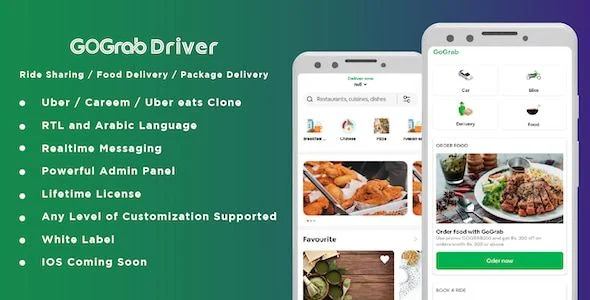
Careem Clone Driver App Overview & On-Demand Dispatch Architecture
Careem Clone Driver App is a native Android application engineered for delivery fleet operators and ride-share service providers to digitize driver-side order fulfillment and passenger dispatch. The package targets the operational bottleneck of coordinating couriers, food delivery riders, and taxi drivers across a local service business without assembling a dispatch stack from zero. Within agency and production workflows, it operates as the driver-facing client of a delivery management system, receiving assignments issued from a back-office admin panel and reporting trip state, map position, and fulfillment events back to the operations layer.
Technical Specifications & Deployment Matrix
The matrix below consolidates the verifiable runtime parameters documented for the package:
| Engineering Metric | Deployment Specification |
|---|---|
| Base Technology / Framework | Native Android application written in Java, compiled in Android Studio |
| Supported OS Runtime | Android 12.0, Android 11.0, Android 10.0, Android 9.0 |
| Included Deliverables | Installable .apk binary plus full .java source code |
| Backend Coordination Layer | Web-based admin panel managing riders, drivers, and dispatch operations |
| Background Execution Engine | WorkManager-based task scheduling with Android 12 notification handling |
| Demo Verification Path | Phone verification code 1234; documented rider and admin demo logins |
Dispatch Pipeline & Driver-Side Execution Flow
The driver client synchronizes trip state with a remote admin panel over REST/JSON exchanges. When a dispatcher creates an order or ride request in the back office, the assignment reaches the driver device as a notification event that the operator accepts or declines. Once accepted, the map module renders route guidance toward the pickup point and destination while the app reports progress back to the panel, giving dispatch staff and customers an Uber-style visibility into each active job. WorkManager schedules the background work that keeps status reporting and location updates running between foreground interactions, and the notification pipeline was reworked for Android 12 so assignment alerts survive Doze and background-restriction states.
For operators evaluating a decoupled customer-facing storefront outside the Android runtime, Zomo exists as an independent PWA template for organic grocery and food ordering flows, developed as a separate codebase rather than a client of this dispatch backend.
Core Technical Capabilities of Careem Clone Driver App
- Native Android Codebase: The application is written in Java and compiled in Android Studio, so teams can rebrand, extend, or refactor the driver workflow directly at source level before producing a signed release build.
- WorkManager Task Scheduling: Deferrable background work keeps order polling and status synchronization alive across process death, replacing ad-hoc service implementations that fail under modern Android background execution limits.
- Android 12 Notification Handling: The November 2022 revision rebuilt notification dispatch for Android 12, preserving assignment alerts under the revised permission model introduced at that API level.
- Optimized Map Module: Map rendering code was refactored in the same revision to reduce the processing overhead of continuous location display during active delivery runs.
- Admin Panel Coordination: A web back office manages rider accounts, driver assignments, and order oversight, letting non-technical staff run dispatch operations without touching the mobile client.
Production Implementation & Operational Resilience
Deployment begins on the server side: the backend and admin panel require PHP-capable hosting, and the vendor documentation names Hostrever as a tested environment for running the panel. The documented demo path lets teams validate the full dispatch loop before committing infrastructure, since phone verification accepts code 1234 and demo rider and admin logins are published for evaluation against the live panel.
Resilience work is concentrated in the November 2022 changelog. Crashing defects were resolved, Android dependency versions were reconciled to eliminate build failures during recompilation, and permission requests were corrected for Android 12 and later, where runtime grants for location and notifications must be explicitly negotiated. These fixes matter in staging environments where the app runs on current-generation devices with aggressive battery and privacy controls.
Because the full .java source ships with the package, secondary development happens inside Android Studio: teams adjust branding assets, repoint the REST endpoints toward their own panel installation, and produce a signed store build for distribution. The APK deliverable allows QA to test the unmodified binary first, establishing a behavioral baseline before source-level changes. For service businesses that prefer to run the storefront layer on WordPress rather than a native client, Waterly offers a parallel drinking-water delivery theme as an independent web-side implementation, not a module of this Android codebase.
Frequently Asked Questions
Does the package include both an installable APK and the editable Java source?
Yes. The deliverables contain a compiled .apk for direct device installation alongside the complete .java codebase, allowing teams to test the baseline binary before recompiling modified builds in Android Studio.
Can this codebase be compiled into an iOS application?
No. The package is a native Android implementation written in Java for Android 9.0 through 12.0, and an iOS release would require a separately developed codebase targeting Apple platforms.
Does one deployment support both parcel or food delivery and taxi ride operations?
Yes. The software is positioned for local delivery businesses and ride-sharing operations alike, with the driver client and admin panel handling courier assignments and passenger dispatch within the same system.
Is the application built with the Flutter framework?
No. Despite cross-platform keywords appearing in the marketplace listing, the code is a native Android project built in Android Studio, and the included source files are .java rather than Dart.
InDrive Bidding Clone- Complete Taxi App with Admin Panel
Careem Clone – All In One Multi Service APP Solution(Taxi, Food and Parcel Delivery)
Full App | Best | Delivery App | Courier | Logistics app | Fleet | Quotation | Bidding| Wallet