Camille – Multi-Concept WordPress Theme
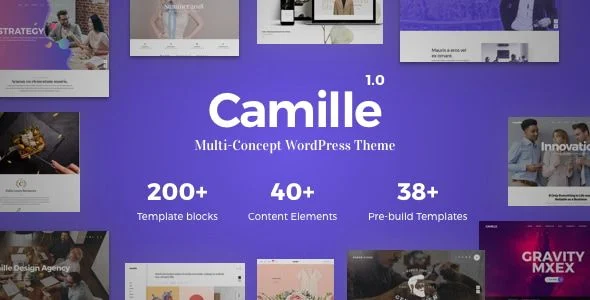
Camille Multi-Concept WordPress Theme Overview & Multi-Demo Composition Engine
Camille Multi-Concept WordPress Theme is a PHP, CSS, and JavaScript codebase built on the LA Framework, engineered for agencies and freelance developers who must deliver business, portfolio, and storefront sites from a single installation. The package resolves the operational bottleneck of licensing and maintaining separate themes per vertical by shipping 29 individually arranged demo sets whose header, footer, blog, portfolio, and commerce components can be mixed across any variant. Within production workflows it acts as the composition layer, pairing WPBakery Page Builder and Slider Revolution with WooCommerce template overrides to compress client delivery timelines.
Technical Specifications & Deployment Matrix
| Engineering Metric | Deployment Specification |
|---|---|
| Base Technology / Framework | WordPress theme on LA Framework; PHP, CSS, and JS source files; child theme bundled |
| Runtime / Language Requirements | WordPress 4.9.x through 6.9.x; WooCommerce 6.x through 10.7.x; standard WordPress server stack |
| Data Exchange / Communication Protocols | AJAX shop operations (filtering, quick view, swatching); Google Fonts API; Google Maps integration; WPML translation registry |
| Front-End / Engine Dependencies | WPBakery Page Builder 8.7.2; Slider Revolution 7.0.12; Contact Form 7, Gravity Forms, Jetpack, WPML compatibility; Font Awesome icon set |
| Database / Persistence Footprint | Native WordPress schema; custom post types for Portfolio, Testimonial, Team, and Custom Block persisted through wp_posts; widget-ready sidebars |
WPBakery Composition & WooCommerce Rendering Pipeline
Camille routes every page through the LA Framework options panel and the WordPress Customizer, while WPBakery Page Builder translates drag-and-drop element trees into server-rendered PHP templates within the standard template hierarchy. The one-click demo importer writes post records, widget assignments, customizer settings, and media attachments in a single provisioning pass, which is why staging environments need adequate PHP memory and execution time before a full demo set with real images is committed to the database. Once provisioned, page-level meta can override the global configuration, so a single install can switch header and footer layouts from page to page or post to post without template duplication.
The commerce layer is where the engineering investment concentrates. Four product grid layouts, four list layouts, and five single-product templates override the native WooCommerce template files, while AJAX handlers re-render filtered product archives without a full page reload. Attribute-driven widgets filter by color and other taxonomies, and the product detail layer supports 360-degree image viewers, color swatch galleries, video thumbnails, custom labels, wishlists, comparison tables, and quick-view modals. Multivendor stacks are also accounted for, with documented compatibility for WC Vendors and Dokan. For teams evaluating a minimalist AJAX storefront running outside this codebase, Savoy Pro exists as an independent WooCommerce theme with its own demo import pipeline and filter architecture, serving as a decoupled alternative rather than an extension of this framework.
Core Technical Capabilities of Camille
- Layout Composition Engine: Six-plus header layouts, a dedicated mobile header, and a footer builder operate through per-page meta overrides, letting developers assign distinct navigation structures to individual posts, pages, and archive views within one database.
- Content Rendering Matrix: Ten-plus blog and portfolio layout combinations (masonry, grid, slider), six-plus portfolio single-item templates, five-plus testimonial and team display styles, plus custom post formats for gallery, quote, link, audio, and video content.
- Commerce Override Layer: WooCommerce templates are overridden at the theme level, adding swatch galleries, 360-degree product imaging, video thumbnails, and AJAX-based attribute filtering while remaining compatible with WooCommerce 6.x through 10.7.x.
- Directionality & Localization: RTL stylesheets ship in the package, WPML compatibility exposes theme strings to the translation registry, and Google Fonts plus Font Awesome are wired into the styling layer for multilingual deployments.
- State Persistence & Navigation: MegaMenu support, sticky and mobile logo separation, back-to-top controls, and two coming-soon styles extend navigation and pre-launch states without additional plugins.
Production Implementation & Operational Resilience
Deployment in agency staging environments follows a predictable sequence: install the parent theme and child theme, verify WPBakery Page Builder 8.7.2 and Slider Revolution 7.0.12 are active, then execute the one-click demo import against a database snapshot so component sets can be mixed or discarded cleanly. The bundled speed optimizer and retina-ready asset handling reduce image payload redundancy, and parallax sections plus 404-page customization are handled through the options panel rather than hard-coded templates. Because the codebase is documented as not Gutenberg-optimized, the block editor functions only at the WordPress core level; WPBakery remains the required composition engine, and teams building native block-based editorial flows should treat that boundary as a pre-deployment prerequisite rather than a post-launch fix.
Secondary development is explicitly supported through the child theme, which isolates functions.php extensions and template overrides from parent updates so version bumps do not overwrite client-specific modifications. Error surfaces are conventional WordPress surfaces: PHP fatals from plugin conflicts, customizer export mismatches, and AJAX endpoint failures during shop filtering, all diagnosable through standard debug logging. For decoupled implementations outside the WordPress theme runtime, Monni exists as a separate creative multi-concept codebase for agencies, an independent design path that cannot be merged into this LA Framework installation.
Frequently Asked Questions
Does Camille support native Gutenberg block editing for page composition?
No, the theme is explicitly documented as not Gutenberg optimized. WordPress core editing remains functional, but all demo layouts, element modules, and page composition run through the bundled WPBakery Page Builder engine instead of native blocks.
Are real images included when the one-click demo importer runs?
Yes, the package documents demo content with actual images, so imported demo sets populate media libraries and template assignments with the same visual assets shown in the preview rather than placeholder graphics.
Can Gravity Forms and Contact Form 7 operate on the same installation?
Yes, both plugins are listed in the official compatibility matrix alongside Jetpack and WPML. Developers can deploy either form handler, or both simultaneously, with template and styling integration already accounted for in the codebase.
-
2.0.0 LatestOct 26, 2026