
 My Account
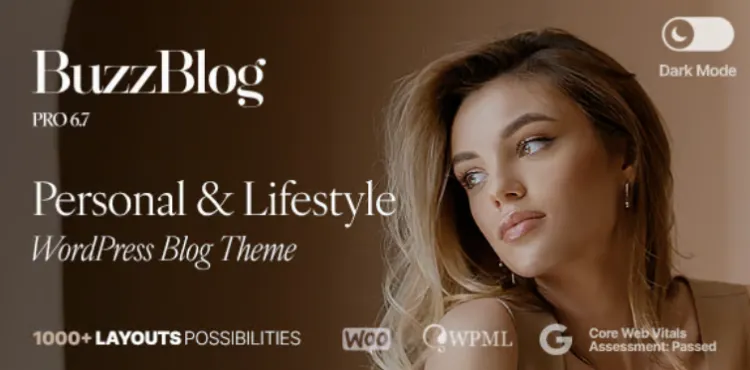
Core Engineering & Layout Architecture of Buzz Pro
Buzz Pro – Personal & Lifestyle WordPress Blog Theme with Dark Mode is a lifestyle WordPress blog theme engineered specifically for travel writers, editorial columnists, and food journalists to publish image-heavy editorial content without degrading Core Web Vitals. The template structure relies on semantic HTML5 landmarks and an unbloated DOM hierarchy that limits page nesting depth to under 8 levels on standard archive pages. By executing asset loading through conditional script enqueueing, the theme prevents unutilized visual components from registering on lightweight single-column layouts.
The native client-side rendering engine controls the dark mode subsystem through CSS custom properties and localized local storage key-value pairs. This execution pattern prevents cumulative layout shifts (CLS) and flash-of-unstyled-theme (FOUT) during document initialization. Instead of invoking heavy client-side UI frameworks, the front-end presentation utilizes pure CSS grid and flexbox primitives, maintaining a total base stylesheet payload below 45 KB when compressed with Gzip or Brotli.
Architectural Capabilities & Implementation of Buzz Pro
- Zero-Latency Color Scheme Toggling: The user preference engine evaluates the system-level
prefers-color-schememedia query at runtime, caching persistent client overrides via vanilla JavaScript before theDOMContentLoadedevent fires. - Decoupled Layout Grid Components: Featured post hero modules, masonry arrays, and multi-column sidebars are rendered through isolated PHP template parts, allowing granular template rewrites inside standard child directory structures.
- Dynamic CSS Variable Hydration: Theme customizer parameters compile directly into an inline CSS declaration block within the document head, avoiding repetitive external stylesheet requests and reducing round-trip latency.
- Deferred Image Evaluation Pipeline: Archive grids utilize native browser-level lazy loading attributes coupled with intrinsic responsive
srcsetcalculations to prevent network congestion across mobile viewports.
Production Use Cases & Enterprise Applications
- High-Frequency Lifestyle Journalism: Ideal for independent publishers producing daily multi-category articles, where efficient visual hierarchies and native categorization trees prevent database query bottlenecks.
- Visual Portfolio & Editorial Essays: Suited for photographers and cultural essayists requiring high-density image presentation alongside balanced typography, without incurring heavy JavaScript runtime penalties.
- Multi-Author Lifestyle Portals: Well-structured for distributed editorial teams where standardized layout configurations and clean typography presets streamline workflow consistency across disparate contributor submissions.
Compatibility & System Requirements
| Component | Specification Standard |
|---|---|
| PHP Runtime Environment | PHP 7.4 through PHP 8.3 (Strict typing enabled, memory limit >= 128M) |
| Core CMS Compatibility | WordPress 5.8+ (Full support for the block editor and dynamic widget blocks) |
| Database Engines | MySQL 5.7+ or MariaDB 10.3+ with UTF8mb4 charset collation support |
| Asset Architecture | Buzz Pro uses CSS custom properties without jQuery dependencies for core UI toggles |
Technical & Integration FAQ for Buzz Pro
Q: How does the dark mode state persist without causing layout shifts on cached pages?
A: An inline script placed directly below the opening body tag checks the visitor’s local storage before rendering child nodes, assigning the dark state class immediately to eliminate visual flashing under reverse proxy caches like Varnish or Nginx FastCGI.
Q: How does this lifestyle WordPress blog theme handle asset optimization for slider components?
A: Slider script bundles and their accompanying styling files are dequeued entirely from memory unless the specific archive or single post template registers the component presence within the primary WordPress query loop.
Q: Can the internal typography definitions be decoupled from remote font CDNs?
A: Typography options can be serviced entirely through self-hosted webfont declarations inside the child theme stylesheet, ensuring zero external third-party requests and complete compliance with regional data privacy mandates.





There are no reviews yet.