Brainrot Jet Ski Racing – HTML5 game – PlayCanvas
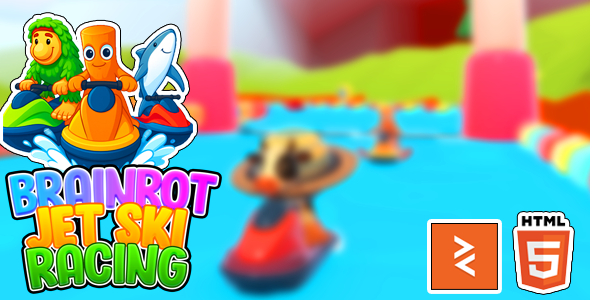
Architectural Analysis & Runtime Mechanics of Brainrot Jet Ski Racing
Brainrot Jet Ski Racing – HTML5 game – PlayCanvas provides an HTML5 racing game framework engineered for web game publishers, portal operators, and interactive media developers seeking modular WebGL arcade deployments. The internal PlayCanvas scene graph isolates WebGL render passes into instanced batch groups, reducing draw calls and avoiding garbage collection spikes through pre-allocated typed array pools for dynamic wave calculations. Asset manifests resolve binary glTF meshes, texture atlases, and audio buffers asynchronously via XMLHttpRequests prior to mounting the primary 60 frames-per-second simulation loop.
Component logic interfaces directly with the PlayCanvas entity-component system, binding custom vehicle rigid bodies, collision hulls, and surface friction scripts into the native physics world. A central JSON configuration file defines vehicle velocity caps, nitro wave boost acceleration multipliers, water surface dampening factors, and audio bus levels without requiring engine script recompilation.
Core Engineering Capabilities & Features in Brainrot Jet Ski Racing
- Dynamic Wave Buoyancy Simulation: The water displacement engine evaluates continuous sine-wave vertex shaders on the GPU while calculating raycast buoyant impulses against the jet ski hull on the CPU physics thread to simulate realistic wave crest launches.
- Dual-Input Controller Mapping: Desktop execution routes directional vectors and acceleration states through WASD, arrow keys, and the spacebar, while mobile touch runtimes project responsive on-screen steering and throttle touchzones dynamically according to viewport dimensions.
- Mid-Air Stunt State Machine: Launching off wave ramps transitions the physics controller into an aerial state that detects shift-key holds or swipe inputs, tracking somersault axis rotations and calculating stunt score multipliers upon clean water re-entry.
- Nitro Wave Acceleration Pipeline: Timing boost triggers at the peak of wave crests scales vehicle linear velocity, applying immediate forward impulse vectors while rendering directional camera field-of-view dilation to represent high-velocity water travel.
Practical Production Implementations
- Browser Gaming Portal Integration: Arcade network operators embed the canvas container via responsive iframes, achieving sub-second asset initialization and steady 60 FPS performance across legacy and modern mobile browsers.
- Gamified Ad Campaign Deployments: Interactive digital agencies wrap the compiled runtime inside rich media advertising units, capturing touch inputs to drive dwell times past 45 seconds without external runtime dependencies.
- Progressive Web App (PWA) Offline Distribution: Mobile webmasters package the static asset bundle with Service Worker cache strategies, enabling instantaneous repeat loads and offline gameplay across mobile viewports.
Runtime Specifications & Environment Compatibility
The software operates entirely on client-side ECMAScript standards, requiring WebGL 1.0 or WebGL 2.0 canvas context support across modern browser runtimes including Chromium, WebKit, and Gecko. Brainrot Jet Ski Racing maintains an average runtime memory footprint below 95 megabytes, preventing browser tab discarding and ensuring responsive main-thread performance during high-frequency physics evaluations.
Standard web servers such as Nginx, Apache, or static content delivery networks host the compiled HTML5, CSS, and JavaScript payload without requiring server-side scripting runtimes or database engines. When deployed as a standalone HTML5 racing game, the asset bundle achieves a Cumulative Layout Shift of zero and keeps Interaction to Next Paint latency beneath 40 milliseconds through optimized WebAudio and pointer event delegation.
Frequently Asked Questions
Does the game require an active backend server to process game states?
No, the codebase executes entirely client-side within the browser WebGL context, handling all rigid-body physics, wave collision detections, and scoring mechanisms locally without requiring external server processes, database connections, or socket handshakes.
How does the engine handle wave physics collision calculations?
Raycast buoyant impulses evaluate mathematical wave displacement functions across four hull contact points, translating vertical water deltas into dynamic angular velocity and pitch stabilization forces across each consecutive fixed-step physics tick.
Can developers rebind touch controls or adjust input sensitivity?
Yes, touch zones map directly inside the input manager script, allowing developers to configure deadzone thresholds, swipe turn multipliers, and virtual button coordinate bounds by adjusting normalized viewport values within the client settings.
How is audio playback initialized without violating browser autoplay policies?
Audio context unlocks immediately upon the first registered user pointerdown or keydown event, transitioning the WebAudio state from suspended to running before loading and decoding positional engine loops, water splashes, and UI audio buffers.
Can the game canvas scale responsively without introducing letterbox distortion?
Yes, the runtime employs PlayCanvas dynamic resolution scaling, adjusting the internal WebGL viewport canvas dimensions to match the parent DOM container aspect ratio while recalculating the camera projection matrix to eliminate visual stretching.
-
15 August 2025 LatestSep 12, 2026