Borrow – P2P Rental & Sharing Marketplace
Borrow P2P Rental Marketplace Overview & Sharing Economy Architecture
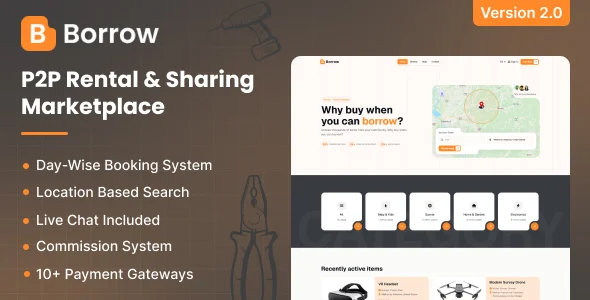
Borrow P2P Rental Marketplace is a Laravel-engineered peer-to-peer rental script, built for developers and agencies that need to launch self-hosted item sharing platforms where owners monetize idle assets and borrowers book them short-term. The package addresses the core coordination bottleneck of the sharing economy: matching geographically dispersed product owners with nearby renters through location-based search, day-wise price calculation, and a commission layer that routes platform revenue to the administrator on every transaction. In production workflows, it functions as the full application runtime — frontend storefront, user dashboards, admin back office, and MySQL persistence — shipped as complete, modifiable source code for custom marketplace deployments.
Technical Specifications & Deployment Matrix
| Engineering Metric | Deployment Specification |
|---|---|
| Base Framework | Laravel 13 (MVC architecture) |
| Runtime Requirement | PHP 8.x server environment |
| Front-End Layer | Bootstrap 5.x, jQuery 3.7.1 |
| Database Persistence | MySQL (database file included in deliverables) |
| Distribution Format | JavaScript, HTML, CSS, PHP, SQL source files |
| Browser Coverage | Chrome, Edge, Firefox, Safari, Opera, IE10/IE11 |
Booking Pipeline, Wallet Flow & Commission Engine
The platform operates on a request-driven booking pipeline that converts search intent into settled, split payments between owner and administrator.
An inbound rental session begins with a location-aware product query; results are filtered by proximity and category before a borrower submits a day-wise booking request with dynamically calculated costs. The owner approves or declines from a dedicated dashboard, after which the platform captures payment through its configured automatic or manual payment gateways. Once a booking completes, the owner’s share settles into an internal wallet, the administrator’s commission is recorded automatically, and the owner raises a withdrawal request that administrators process through configured payout methods. Every state change — request, approval, payment, withdrawal, dispute — is logged into transaction records visible to both role panels.
Architectural & Functional Highlights
- Location-Based Discovery Engine: Product queries resolve against a configurable map/location API, so listings surface by geographic proximity rather than catalog order — the mechanism that makes neighborhood-scale rental viable.
- Role-Segregated Dashboards: Users, owners, and administrators operate distinct panels; admin-side role and permission controls gate access to category management, booking oversight, user bans, and KYC identity verification queues.
- Real-Time Messaging & Disputes: A built-in messaging channel synchronizes borrower-owner communication inside each booking context, while support ticket and dispute management modules give administrators an arbitration layer between the parties.
- Multi-Gateway Payment Configuration: Both automatic and manual gateway types are configurable per deployment, accommodating markets where manual transfer confirmation is standard practice.
- Verified-Trust Layer: KYC identity verification, product and owner ratings, and email/SMS notification templates combine to establish accountability across anonymous peer transactions.
For delivery teams evaluating a parallel Laravel reservation runtime outside the peer-to-peer model, Carento represents an independent single-vendor booking system, while agencies building hiring platforms on the same framework can study Jobs Portal as a separate matching-marketplace codebase.
Production Implementation & Operational Resilience
Deployment requires a PHP 8.x host with a MySQL database; the included SQL file initializes the schema, and the accompanying installation documentation walks through environment configuration. Because the entire source is exposed — controllers, migrations, views, and assets — engineering teams can modify any layer directly rather than working around compiled or obfuscated code. The admin panel exposes a custom CSS injection point, global settings, and CMS controls for frontend section ordering, which covers most brand-level adjustments without touching blade templates. Multi-language support allows localization of the storefront and dashboards for regional markets. Operational safeguards include reCAPTCHA protection, GDPR cookie policy handling, configurable privacy pages, and granular email/SMS notification settings — each controllable from the back office. Platform operators running retention campaigns through WhatsApp can run WhatsJet SaaS as a separate marketing channel alongside the marketplace, keeping campaign load off the rental application itself. Transaction integrity is preserved through earning reports, transaction logs, and withdrawal request management, giving administrators an auditable financial trail. The version 2.0 release upgraded the codebase to Laravel 13, redesigned the admin panel interface, resolved a KYC-related defect, and applied speed optimizations — evidence of an actively maintained release line.
Frequently Asked Questions
Does the deliverable include the complete, editable source code?
Yes. Buyers receive the full source code across JavaScript, HTML, CSS, and PHP, together with a MySQL database file and installation documentation, enabling direct code-level customization of the entire application stack.
Can administrators control how owner earnings are paid out?
Yes. The admin panel includes withdrawal method setup and withdrawal request management, so payout channels are defined centrally and each owner’s earning release is reviewed or processed by the platform administrator.
Is identity verification available to restrict untrusted participants?
Yes. A KYC identity verification module is integrated, letting administrators review submitted user documents and gate marketplace participation, complemented by a user ban system for policy enforcement.
Does the platform support multiple languages for international deployments?
Yes. Multi-language capability is listed among the core features, allowing the frontend interface and user-facing panels to be translated for non-English markets without altering the underlying Laravel codebase.
-
1.0.0 LatestOct 28, 2026