Bomb Chips – Two Player HTML5 Game
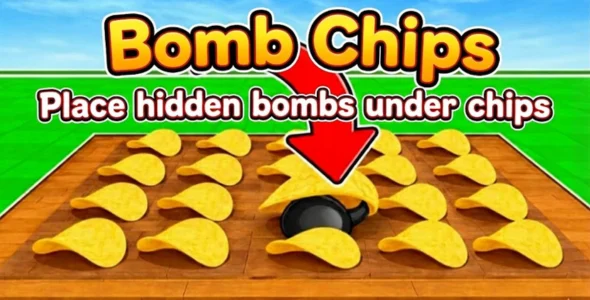
Bomb Chips Overview & Pass-and-Play Strategy Engine
Bomb Chips is an HTML5 two-player strategy game source package, engineered for web developers and casual-game publishers to ship a turn-based pass-and-play title across desktop and mobile browsers. The package resolves the hot-seat delivery bottleneck: two players compete on a single device, taking turns eating chips while hidden explosive traps inject risk into every selection, and all game logic executes client-side without a backend. Within agency delivery workflows it functions as a drop-in static asset, distributed as JavaScript, HTML, and CSS files that upload to any web host or embed into existing portals without server provisioning.
Technical Specifications & Deployment Matrix
| Engineering Metric | Deployment Specification |
|---|---|
| Base Technology / Framework | HTML5 game authored in vanilla JavaScript, HTML, and CSS |
| Runtime / Browser Requirements | Internet Explorer 11, Firefox, Safari, Opera, Chrome, and Edge |
| Deliverable File Manifest | JavaScript JS, HTML, and CSS source files |
| Front-End / Engine Dependencies | No external engine dependency; executes on the native browser runtime |
| Database / Persistence Footprint | No database; match state is held in client-side memory for the session |
| Display Output | High-resolution rendering with fully responsive viewport scaling |
Turn-Based Game Loop & Execution Pipeline
The engine executes a synchronous, turn-based state machine that resolves every chip selection entirely inside the browser. Each player interaction enters through a touch-friendly input layer that normalizes taps and clicks into a single event path, so the same handler serves desktop pointers and mobile touchscreens without parallel code branches. The interaction is validated against the active player flag, the selected chip is checked against the opponent’s hidden trap data, and the resulting outcome is pushed to the render loop while interactive sound effects are dispatched on the corresponding gameplay events. Because trap placement is concealed from the opposing player, every turn becomes a probability-and-bluff calculation, which is where the strategic depth of the loop resides. The concept is inspired by the popular Roblox game of the same name, while this implementation applies its own twist tuned for web and casual play rather than porting the original mechanics wholesale.
Core Technical Capabilities of Bomb Chips
- Local turn-state synchronization: Player alternation is tracked in an in-memory state object, keeping two-player sessions consistent on one device with no network round-trips or matchmaking infrastructure.
- Unified pointer and touch input layer: Touch-friendly controls map tap and click gestures to one dispatcher, reducing input-handling code and guaranteeing identical behavior across phone, tablet, and desktop viewports.
- Customizable theme and re-skin layer: Theming is exposed as a configurable layer, letting studios swap palettes and graphics without rewriting core game logic, which shortens re-skin cycles for branded deployments.
- Interactive audio feedback: Sound effects are bound to gameplay events such as chip selection and trap detonation, giving players immediate confirmation of each resolved action.
- Responsive rendering: The layout adapts to varying screen geometries, and studios evaluating a parallel Construct-based production path can study Goal Quest as an independent HTML5 title built on a different engine stack.
Production Implementation & Operational Resilience
Deployment follows a static-asset model: copy the HTML, CSS, and JavaScript files to any web server or static host and the game runs immediately, since no server-side runtime, database connection, or build pipeline is required. Because all assets ship from the same origin as the page, cross-origin resource sharing headers are not a factor in standard deployments, which removes an entire class of CORS configuration errors during client staging. The lightweight file footprint keeps initial load times short even on constrained mobile networks, and the documented compatibility envelope reaching back to Internet Explorer 11 means the codebase already accounts for legacy browser behavior, reducing QA surface for agencies maintaining older client environments. The package is also tagged for PWA usage, so it can sit inside a progressive web app shell where one is already in place. For secondary development, customization should stay within the documented boundaries: theme colors, graphics, and sounds can be replaced through the re-skin layer, while deeper changes to the trap logic or turn rules require direct modification of the JavaScript source. Teams assembling a broader casual-games catalog on separate source code can treat Educational Game Bundle #01 as an independent acquisition path covering multiple HTML5 titles authored in Construct 2 or 3. The codebase also wraps cleanly into native webview containers for hybrid mobile distribution, since it carries no backend calls that would break inside a sandboxed shell.
Frequently Asked Questions
Can two players compete on a single device without any server connection?
Yes, the game is built as a pass-and-play experience where both players share one screen and alternate turns, with the entire match state managed locally in the browser during the session.
Does the engine support touch input on smartphones and tablets?
Yes, touch-friendly controls are a documented feature, allowing chip selection through taps on mobile hardware alongside standard mouse clicks on desktop systems.
Are authoring files beyond JavaScript, HTML, and CSS included in the deliverable?
No, the documented file manifest lists only JavaScript JS, HTML, and CSS, so buyers working in visual game editors should plan modifications through the provided source files.
Can the visual theme be re-skinned without altering the core game logic?
Yes, customizable themes and an easy re-skin workflow are documented features, enabling graphics and color replacements through the theme layer while leaving the underlying turn and trap mechanics intact.