Bollsket – Basketball Club & Sport Elementor Template Kit
Bollsket Overview & Basketball Club Design System Architecture
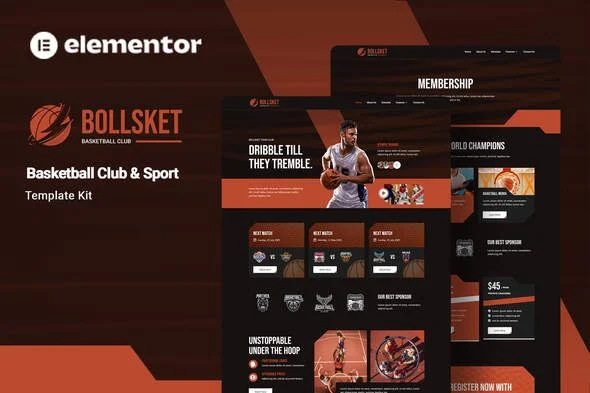
Bollsket is a basketball club and sports team Elementor Template Kit, engineered for agencies and club webmasters to deploy a branded athletic web presence without composing page layouts from scratch. The package eliminates the repetitive build-out of schedule, roster, membership, and trophy showcase pages by shipping prebuilt design data that imports directly into the Elementor page builder. In production workflows it operates as the presentation layer for clubs, leagues, and competition organizations running on the free Hello Elementor theme, with all templates transferred through the Envato Elements plugin for WordPress.
Technical Specifications & Deployment Matrix
| Engineering Metric | Deployment Specification |
|---|---|
| Base Technology / Framework | Envato Template Kit targeting Elementor 3.10.x on the Hello Elementor theme |
| Runtime / Language Requirements | WordPress with free Elementor; Flexbox Container feature active; Elementor Pro optional |
| Data Exchange / Communication Protocols | Single ZIP kit file imported via the Envato Elements plugin, uploaded unzipped through Installed Kits |
| Front-End / Engine Dependencies | Elementor, ElementsKit, Jeg Elementor Kit, MetForm; Bebas Neue and Roboto typefaces |
| Database / Persistence Footprint | No standalone persistence; imported designs persist as Elementor Saved Templates (JSON layout structures) |
Template Import Pipeline & Design System Execution
The core mechanism is a two-stage import: Global Kit Styles first, then individual page templates.
During stage one, the Global Kit Styles payload writes the site-wide design tokens into the Elementor site settings layer, synchronizing typography (Bebas Neue for display headings, Roboto for body copy), the color palette, and the dark mode treatment across every subsequently imported template. Skipping this stage desynchronizes the design tokens, forcing manual re-mapping of fonts and colors on each page. Stage two imports one template at a time in the displayed order; each lands in Elementor under Templates > Saved Templates as a reusable JSON layout structure that should not be edited directly.
Layouts are built on Flexbox container architecture rather than legacy section and column wrappers, which is why the Flexbox Container feature must be set to Active under Elementor > Settings > Features before import. The ten included templates — Home, About Us, Schedule, Membership, Trophy, Team, Blog, FAQs, Error 404, and Contact Us — cover the full content surface of a club site, including competition fixtures and trophy galleries.
Header construction routes through the Jeg Elementor Kit plugin rather than native theme files: a new header template is created, assigned the All Site display condition, and populated from the saved header template inside the Elementor editor. Contact forms follow a parallel path via MetForm blocks, inserted through the Navigator and wired to the imported form template.
Architectural & Functional Highlights
- Global Kit Styles token propagation: One import synchronizes typography, colors, and dark mode styling across all ten templates, keeping the design system consistent without per-page overrides.
- Flexbox container layout architecture: Pages render through Elementor Flexbox containers, requiring the feature flag to be active and producing fully responsive layouts without custom CSS grid code.
- MetForm form pipeline: Contact and membership inquiry forms import as dedicated blocks, attached to page templates through the Navigator widget rather than hardcoded form markup.
- Jeg Elementor Kit header conditions: Site-wide headers publish under an All Site display condition, decoupling the masthead from the theme’s template hierarchy.
- Hand-picked demo imagery: Pre-licensed-source athletic photography from Envato Elements gives the kit a branded starting point, replaceable with club-owned assets.
Agencies serving clients outside the basketball vertical can evaluate parallel kits on the same Elementor runtime — Sportivo covers extreme sports clubs and community sites with the same import pipeline, while Funnia addresses digital agency landing pages for mixed client rosters.
Production Implementation & Operational Resilience
Pre-deployment prerequisites are strict and ordered. The permalink structure must be set to Post Name under Settings > Permalinks before any import occurs, and Hello Elementor must be installed and activated via Appearance > Themes, which itself triggers the Elementor installation prompt. Elementor and the Envato Elements plugin must both sit at their latest versions; the orange banner in the Installed Kits screen exposes an Install Requirements action that loads ElementsKit, Jeg Elementor Kit, and MetForm in one pass. Because import payloads decompress inside the browser-adjacent PHP runtime, hosting environments should carry a healthy wp_memory_limit allocation so larger template JSON does not abort mid-import.
Page assembly follows a deterministic pattern: create a new page, open it in Elementor, set Elementor Full Width and hide the page title through the lower-left gear icon, then pull the desired layout from the My Templates tab. The homepage is bound under Settings > Reading by selecting a static front page. A known environmental gotcha affects Safari users — the browser’s “Open safe files after downloading” preference must be disabled so the kit ZIP is not auto-extracted before upload, since the file must reach Elementor intact.
Customization boundaries matter for long-term maintainability. Saved Templates should be duplicated into pages and edited there, never modified in the templates repository, preserving clean originals for re-deployment. Demo images originate from an Envato Elements collection and must be licensed there or swapped for club-owned photography before go-live. Error states are handled by the included Error 404 template, and Form widgets validate input through MetForm’s own field rules rather than server-side theme logic.
Frequently Asked Questions
Is Elementor Pro required to run this template kit?
No, the kit is built for free Elementor and all ten templates import without a Pro license. Pro becomes relevant only for customizing headers and footers through the Theme Builder, while the bundled Jeg Elementor Kit handles headers on free installations.
Is Bollsket a standalone WordPress theme?
No, this is an Envato Template Kit containing Elementor design data only, not a theme package. It must run on the free Hello Elementor theme, with layouts installed through the Envato Elements plugin rather than the Appearance > Themes screen.
Must the Flexbox Container feature be enabled before importing the templates?
Yes, Flexbox Container must be set to Active under Elementor > Settings > Features on existing installations. The page layouts are constructed from Flexbox containers, so disabling the feature breaks the intended layout structure during import.