Bolby – Portfolio/CV/Resume WordPress Theme
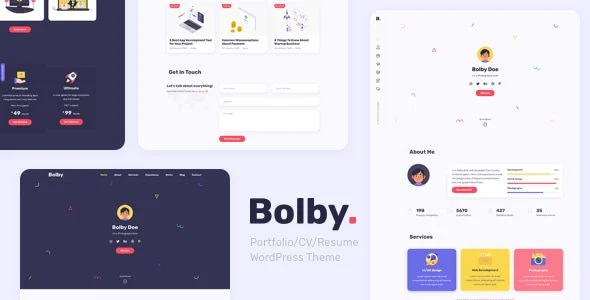
Bolby Portfolio/CV/Resume WordPress Theme Overview & One-Page Personal Site Engine
Bolby Portfolio/CV/Resume WordPress Theme is an Elementor-driven WordPress theme engineered for freelancers, job seekers, and digital agencies to publish personal portfolio, CV, and resume websites without writing code. The package removes the bottleneck of hand-building single-page personal sites by shipping 9 pre-made demo styles, a one-click demo importer, and 10+ custom Elementor widgets that map skill bars, experience timelines, and portfolio grids onto a Bootstrap 4 layout. Within production delivery workflows, it operates as a rapid-deployment shell: a developer imports a demo, edits content through the live customizer and the Elementor canvas, and ships a responsive one-page site.
Technical Specifications & Deployment Matrix
| Engineering Metric | Deployment Specification |
|---|---|
| Base Technology / Framework | WordPress theme built on Bootstrap 4.x with the Elementor page builder engine |
| Runtime / Language Requirements | WordPress 4.9.x through 7.0.x; PHP, CSS, and JS deliverables with Sass source files |
| Data Exchange / Communication Protocols | Contact Form 7 submissions; Ajax Load More portfolio fetching; WPML multilingual data binding |
| Front-End / Engine Dependencies | Elementor, Gutenberg editor compatibility, WooCommerce 5.x through 10.x |
| Database / Persistence Footprint | Standard WordPress schema; widget-ready regions including header widget areas |
Elementor Rendering Pipeline & Core Functional Capabilities
Bolby composes every page through the Elementor page builder’s widget-based rendering engine. When a visitor requests a URL, WordPress resolves its template hierarchy and the Elementor engine parses the stored layout data to assemble the DOM tree from widget instances, including the theme’s 10+ custom widgets for timelines, skills, and portfolio grids. Because layout data lives in structured widget records rather than hard-coded PHP templates, content editors reorder and restyle blocks visually while the emitted markup stays W3C-valid.
The one-page scroll architecture anchors navigation links to section IDs, so the browser scrolls within a single document instead of issuing fresh requests for each section. Portfolio grids push past static pagination: the Ajax Load More routine fetches additional portfolio posts asynchronously and injects them into the existing grid, while the infinite-scroll variant triggers the same fetch as the viewport approaches the grid boundary. Display state is governed by a dark and light mode switcher that swaps the color scheme across the rendered page, and version 1.0.1 refined this toggle after release feedback. Three header layouts, plus a widget area added to headers specifically to host language switchers, expand the template regions available for navigation and multilingual controls. The theme also ships over 2000 icons and free Google web fonts, so glyph and typography choices happen at the configuration layer rather than through asset replacement. For studios whose client briefs lean toward expressive agency presentations, Munich offers a parallel WordPress portfolio option inside the same self-hosted deployment model.
Architectural & Functional Highlights
- One-click demo importer: nine pre-built demo styles are pushed into the WordPress installation in a single operation, populating posts, widgets, and customizer settings so deployment starts from a populated state rather than an empty shell.
- Live customizer integration: site identity, header layout, and display parameters are managed through the WordPress Customizer, with changes reflected in the preview pane before publication.
- Gutenberg-optimized markup: the theme remains editable through the native block editor, giving teams a fallback authoring path when Elementor is not active on a given page.
- Commerce and multilingual layer: WooCommerce support, integrated in version 1.0.1 and verified through WooCommerce 10.x, adds product and checkout flows, while WPML support handles translated content routing.
- Asynchronous portfolio pagination: Ajax loading and infinite scroll reduce initial page weight by deferring portfolio post retrieval until user interaction demands it.
Production Implementation & Operational Resilience
Deployment targets any host running WordPress 4.9.x through 7.0.x, and the changelog records continued maintenance: Elementor and WordPress compatibility were re-verified in the October 2024 release, with further Elementor support and an icon HTML fix shipped in January 2025. The cross-browser matrix spans IE9 through Edge alongside Firefox, Safari, Opera, and Chrome, which constrains the CSS feature set the front-end can safely rely on; Bootstrap 4’s grid system carries responsive behavior across breakpoints with column configurations of four and up.
Form ingestion routes through Contact Form 7, so field validation and mail transport delegate to that plugin’s handler rather than theme-level code. Commerce deployments run against WooCommerce 5.x through 10.x, meaning product, cart, and checkout state persists in WooCommerce’s standard tables with no bespoke schema to migrate. For secondary development, the included Sass sources let teams adjust design tokens such as color variables at the source layer and recompile the stylesheet, instead of stacking overrides on compiled CSS; the shipped PHP templates remain directly accessible when markup structure itself must change. Header widget areas provide an extension point for adding controls such as language switchers without touching template files. For decoupled implementations outside the WordPress runtime, Rivor represents an independent Next.js path for agency showcase builds.
Frequently Asked Questions
Are Sass source files included in the deliverable package?
Yes. The download ships PHP, CSS, JS, and Sass files, so developers can modify the styling layer at the source-token level and recompile the output instead of patching compiled stylesheets after each release.
Can a language switcher be placed in the header without editing template files?
Yes. Version 1.0.1 introduced a widget area on the headers expressly for hosting a language switcher, which pairs with the theme’s documented WPML support for multilingual deployments.
Are timeline icons fixed, or can each milestone glyph be changed?
Yes, they are changeable. Version 1.0.1 made timeline icons selectable, meaning each milestone’s icon can be swapped through the widget controls instead of being locked to a default glyph set.