Bixola – Multipurpose Business Service WordPress Theme
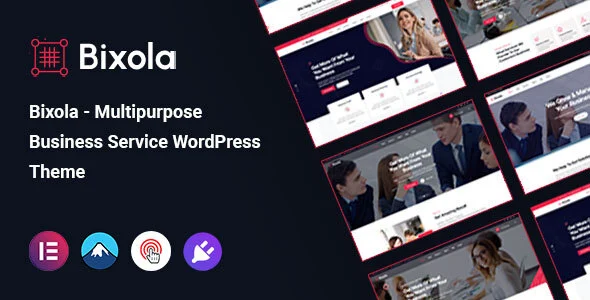
Bixola Multipurpose Business Service WordPress Theme Overview & Corporate Service Site Foundation
Bixola Multipurpose Business Service WordPress Theme is an Elementor-driven WordPress theme engineered for agencies and freelance developers building consulting, finance, and corporate service websites without hand-coded templates. The package removes the bottleneck of constructing service-business layouts from scratch by shipping five pre-built homepages, 28 custom Elementor widgets, and four header plus four footer variants that render through a drag-and-drop editing pipeline. Within production agency workflows, it operates as the presentation layer for consultants, accountants, brokers, insurance providers, and financial advisors who need a deployable client site inside a single staging cycle.
Technical Specifications & Deployment Matrix
| Engineering Metric | Deployment Specification |
|---|---|
| Base Technology / Framework | Underscores starter core; Bootstrap 5.x front-end grid; Elementor page builder engine |
| Runtime / Language Requirements | WordPress 5.7.x through 6.5.x; PHP files with valid HTML5/CSS3 output; jQuery-dependent JavaScript |
| Data Exchange / Communication Protocols | Contact Form 7 form submission handling; translation-ready codebase for multilingual routing |
| Front-End / Engine Dependencies | jQuery, OwlCarousel2, Magnific-popup, FontAwesome 6.7.2, Google Fonts (Roboto, Inter Tight) |
| Database / Persistence Footprint | Standard WordPress schema; widget-ready sidebars; Kirki Customizer option storage |
Elementor-Driven Rendering & Execution Pipeline
The core mechanism is Elementor’s drag-and-drop rendering engine layered over an Underscores-based template hierarchy. When a visitor requests a page, WordPress resolves the route through the theme’s Underscores-derived file structure, and Elementor then intercepts content output, assembling the DOM from widget modules rather than fixed PHP layouts. Bixola registers 28+ custom widgets that extend Elementor’s native palette with service-business components, so consultant profiles, finance sections, and agency portfolios are composed directly on the builder’s visual canvas. Four header and four footer variations are exposed as selectable structures, letting each deployment shift identity chrome without touching markup. Agencies running parallel niche engagements — freight, trucking, or shipping clients, for instance — can cover that vertical with Kargon on the same WordPress delivery pipeline while keeping this codebase untouched.
Architectural & Functional Highlights
- 28+ Custom Elementor Widgets: Each widget is a self-contained rendering module registered with the builder, allowing teams to compose service grids, statistic counters, and team sections through drag-and-drop instead of authoring template markup by hand.
- One-Click Demo Importer: The importer writes five pre-built homepage structures and their supporting pages into the database, so content editors replace placeholder copy and imagery rather than constructing layouts from an empty canvas.
- Kirki Customizer Settings Layer: Header and footer configuration persists through the Customizer interface, keeping visual decisions inside the options API and away from direct template file edits.
- Bootstrap 5.x Responsive Grid: Layouts resolve against Bootstrap’s mobile-first breakpoints with retina-ready asset handling, so a single DOM renders correctly across desktop monitors, iPads, iPhones, Android devices, and tablets.
Production Implementation & Operational Resilience
Deployment follows the standard WordPress theme path: upload the package via FTP or the admin appearance screen, activate it, then trigger the one-click importer to populate demo content before substituting client material. The changelog records an iterative release cadence — core plugin refreshes in v1.0.2 and v1.0.3, plus a demo-import correction in v1.0.1 — which indicates the importer and companion plugin receive corrective maintenance, a relevant factor when staging repeated installs across multiple client projects.
Several operational boundaries deserve attention before rollout. The package is not Gutenberg-optimized: authoring routes exclusively through Elementor, so teams standardized on the native block editor should treat this as a hard constraint. The front-end depends on jQuery, OwlCarousel2, and Magnific-popup, so asset concatenation and minification at the server or caching layer reduce request fragmentation on widget-heavy pages. Cross-browser verification spans IE11, Firefox, Safari, Opera, Chrome, and Edge. For engagements that expand beyond brochure sites into storefront territory, Modave exists as a separate WooCommerce-oriented build running on the same WordPress runtime. Widget-ready sidebars, valid HTML5/CSS3 markup, and commented source keep the codebase inspectable for secondary development, while the bundled documentation and video guides walk through setup and customization procedures step by step.
Frequently Asked Questions
Can pages be authored in the native Gutenberg block editor instead of Elementor?
No, the package is not Gutenberg-optimized; layout authoring routes through the Elementor builder and its 28+ custom widgets, and the shipped demo pages assume that specific rendering path for full structural fidelity.
Does the front end render correctly on legacy Internet Explorer 11?
Yes, cross-browser compatibility extends across IE11, Firefox, Safari, Opera, Chrome, and Edge, so enterprise networks still running older Microsoft browsers receive a functional rendering of the Bootstrap-based layout.
Can multilingual versions of the site be managed with WPML?
Yes, the codebase is translation-ready and compatible with WPML, so agencies can mirror Elementor-built layouts across multiple language trees and manage translated content through that plugin’s routing.
-
1.0.3 LatestOct 25, 2026