Big Push – (Unity – Admob – Game)
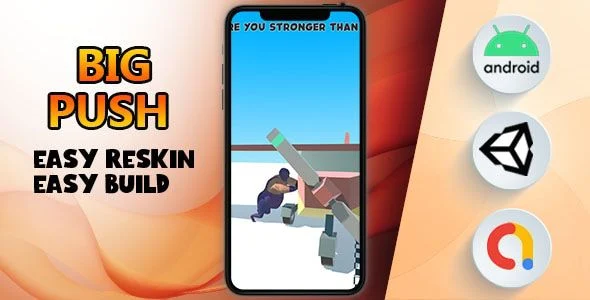
Big Push Overview & Mobile Game Foundation Architecture
Big Push is a Unity mobile game source code engineered for indie developers and small studios to launch a physics-based hyper-casual title without assembling an engine from scratch. The package resolves the core production bottleneck in casual game delivery: consolidating collision logic, autonomous opponent AI, character growth progression, and ad monetization into one deployable codebase. Within an agency release pipeline, it operates as a store-ready foundation that moves a project from acquisition to app store submission after art reskinning and ad unit configuration.
Technical Specifications & Deployment Matrix
| Engineering Metric | Deployment Specification |
|---|---|
| Base Technology / Framework | Unity engine with C# scripting; complete, editable project source |
| Runtime / Platform Targets | Android and iOS mobile builds compiled through the Unity editor toolchain |
| Monetization Layer | Google AdMob SDK pre-configured for banner and interstitial ad formats |
| Input & Gameplay Model | One-touch controls; physics-based arena elimination with endless progression |
| Backend / Persistence Footprint | Client-side execution only; the documented package contains no server-side components |
Physics Elimination Loop & Execution Pipeline
The core execution mechanism routes one-touch directional input into a character controller that resolves collisions through the physics engine against AI-driven opponents. Each successful elimination — an opponent forced off the arena edge — feeds back into the player entity by increasing its size and strength, which enlarges the effective collision footprint and amplifies push force in subsequent encounters. This feedback loop is the retention architecture: growing mechanical advantage makes each session feel progressive while the arena threat scales continuously.
Opponent entities run autonomous AI routines that pursue and contest the player rather than following scripted paths, producing varied match states without hand-authored level content. Because the gameplay model is endless, the encounter system generates opposition indefinitely, and session length is bounded only by player elimination, which naturally creates a retry-driven engagement pattern suited to interstitial ad placement between runs. For studios diversifying a portfolio with a second standalone Unity title, Vegetable Smash Match ships as an independent match-3 codebase carrying the same AdMob stack, operating as a fully separate project rather than an extension of this one.
Core Technical Capabilities of Big Push
- Physics-Driven Elimination Loop: Collision outcomes — pushes, displacement, and edge falls — are computed by the physics engine rather than scripted animations, so match results depend on mass, velocity, and positioning at the moment of contact.
- Progressive Growth Scaling: The player entity’s size and strength parameters increase with each elimination, translating directly into a larger collision volume and greater shove output that compounds over a session.
- Autonomous Opponent AI: Rival entities apply behavioral logic that contests the player dynamically, delivering a consistent challenge without level-by-level authoring overhead.
- Integrated AdMob Monetization: Banner and interstitial placements are wired into the build, with configuration points ready for publisher ad unit IDs during the build preparation phase.
- Reskinnable Art Layer: The visual presentation uses a flat, colorful style structured for asset replacement, allowing rebranding without touching gameplay logic.
Production Implementation & Operational Resilience
Deployment follows the standard Unity release path: open the project in the Unity editor, insert your own AdMob application and ad unit identifiers into the monetization configuration, replace or rebrand the art assets, and produce release builds for Android (via the Gradle toolchain) and iOS (via Xcode). The package is structured for publication to major app stores, meaning store-listing assets, icon slots, and build identifiers are the remaining operator inputs rather than architectural gaps.
Performance-wise, the codebase is optimized to run smoothly across a broad range of iOS and Android hardware rather than targeting flagship devices exclusively. Operators tuning difficulty or feel should work through the physics parameters — rigidbody mass, drag, and force magnitudes — since every elimination outcome derives from those values. One operational boundary deserves emphasis: AdMob placements do not serve live inventory until valid publisher credentials and ad unit IDs are supplied, so ad verification should be scheduled before store submission, not after.
Reskinning is intentionally bounded to the asset layer. Replacing sprites, colors, and branding does not require modifying the C# gameplay modules, which keeps visual rebranding decoupled from the physics and AI logic. As an entirely separate native-code path outside the Unity runtime, Hidden Camera Detector Swift exists for teams that also ship Swift-based iOS utilities with the same AdMob monetization layer.
Frequently Asked Questions
Do I need to supply my own AdMob publisher and ad unit IDs before advertisements become active?
Yes. The build ships with AdMob placements wired for banner and interstitial formats, but live ad serving requires inserting your own AdMob application and ad unit identifiers during configuration before compiling a release build.
Can the game be visually rebranded without modifying the gameplay code?
Yes. The art layer uses a flat, colorful style structured for reskinning, so replacing visual assets and branding can be performed at the asset level while the physics, AI, and progression modules remain untouched.
Is the package structured for direct submission to both Google Play and the Apple App Store?
Yes. The project is prepared for deployment to major app stores on Android and iOS, leaving build identifiers, store listings, and ad configuration as the remaining operator tasks before submission.
Pro 4K Wallpaper 2024 & Photo Editor System – AdMob & Facebook Bidding Ad & Push Notifications
All in One QR Barcode Scanner & Generator +Admob+OneSignal Push Notification Android App
[TS] DocScan Android – A mini and Powerful mobile scanner (Admob, IAP, Push Notifications)