BerqWP – Core Web Vitals & Pagespeed Optimization
BerqWP Overview & Automated Performance Engineering Layer
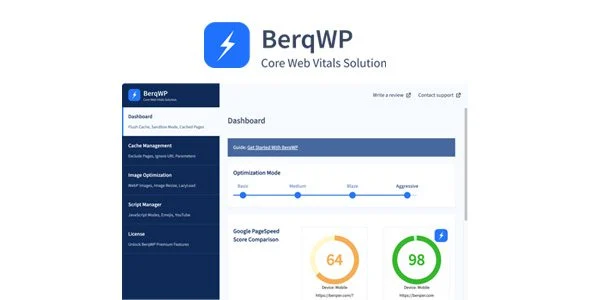
BerqWP is a WordPress performance plugin engineered for agencies, WooCommerce store owners, and non-technical publishers to pass Core Web Vitals and reach 90+ PageSpeed scores on both mobile and desktop automatically. The package exists because manual Core Web Vitals remediation — critical CSS generation, render-blocking script deferral, image and web font delivery tuning, cache lifecycle management — typically demands subject-matter expertise measured in engineering hours per template. Within production workflows, the module installs as a standard plugin, applies Google-recommended optimization methods across the full site, and then operates in the background so agencies can ship client sites without retaining a dedicated performance engineer.
Technical Specifications & Deployment Matrix
| Engineering Metric | Deployment Specification |
|---|---|
| Base Technology / Framework | WordPress plugin (PHP), operating at the page-render and asset-delivery layer |
| Runtime / Language Requirements | Standard WordPress hosting stack; runs on virtually every hosting setup with no server-level prerequisites |
| Data Exchange / Communication Protocols | HTTP/HTTPS asset delivery extended by the BerqWP CDN for static images, CSS, JavaScript, and web font files |
| Front-End / Engine Dependencies | None mandatory; verified compatibility with Elementor, WooCommerce, WPML, Divi, and all major themes and plugins |
| Database / Persistence Footprint | Server-side cache storage with automatic invalidation on content publish or update events |
Automatic Optimization Engine & Execution Pipeline
The engine applies modern optimization methods recommended by Google across the rendered page output, then serves the optimized result from cache. At its core, the pipeline intercepts the ordinary WordPress rendering flow, rewrites how CSS, JavaScript, images, and web fonts are delivered to the browser, and stores the resulting optimized artifact so subsequent visitors bypass the expensive transformation entirely. Because the plugin targets the Google-documented factors behind LCP, CLS, and INP — the same signals measured by CRuX field data — the outcome maps directly to Core Web Vitals evaluation rather than abstract lab numbers.
Cache lifecycle management is event-driven rather than cron-dependent: publishing or updating content triggers an automatic cache refresh, and newly added pages enter the optimization queue as they are created. Nothing has to be triggered, scheduled, or monitored manually. The vendor reports a customer base above 4,000, more than 1 million optimized websites, and average achieved scores in the 94–96 range. An independent WooCommerce evaluation documented better resulting speed metrics than both Hummingbird Pro and WP Rocket Pro under identical test conditions. For teams evaluating parallel solutions on the same platform, Hummingbird Performance Pro remains a comparable caching and Core Web Vitals toolkit, and agencies typically benchmark both engines against the same baseline before committing a client stack.
Core Technical Capabilities of BerqWP
- Top-Notch PageSpeed Score Automation: Achieves high PageSpeed results for mobile and desktop without manual configuration, applying optimization transformations that address Google’s scoring criteria directly and improving user experience through instantly loading pages that rank better on SERPs.
- Zero Configuration Setup: Requires no settings entry, no technical tuning, and no prior PageSpeed knowledge; the intelligent algorithms determine the appropriate optimization strategy for the detected theme and plugin stack at activation time.
- Autopilot Cache Lifecycle: Dispatches automatic cache refreshes on content publish and update events, enqueues newly created pages for optimization, and eliminates every manual trigger, schedule, or monitoring task from the operator’s workflow.
- BerqWP CDN Delivery: Serves static files — images, CSS, JavaScript, and web font files — from a distributed CDN, making pages ready to interact with within milliseconds for globally distributed visitors.
- Non-Technical Operator Accessibility: Converts hours of manual optimization labor into a few clicks, with no coding skills required at any point in the deployment or maintenance cycle.
Production Implementation & Operational Resilience
In agency delivery and high-traffic client environments, the deployment model is deliberately minimal: activate the plugin and the optimization layer begins operating, which removes the misconfiguration risk that typically accompanies multi-setting performance stacks. Because the package is verified against Elementor, WooCommerce, WPML, and Divi, staging-to-production promotion does not require a compatibility audit pass for the most common builder, commerce, and multilingual combinations, and it runs on virtually every hosting setup. This matters for WooCommerce storefronts in particular, where cart, checkout, and product archive templates each carry distinct asset payloads that a generic caching layer can break if its exclusion rules are hand-tuned incorrectly.
Resilience comes from the automatic invalidation model rather than operator vigilance. When a merchant publishes a new product, updates a post, or modifies a template, the cache refreshes itself, so stale optimized artifacts are not served to shoppers — the classic failure mode of static cache layers with manual purge buttons. Performance-sensitive theme selection compounds the benefit: a lightweight foundation such as Swyft Pro – PageSpeed Optimized WordPress Blog Theme reduces the raw DOM and asset complexity the optimizer must process, shortening the optimization pass itself. As with any performance layer, operators should validate third-party tracking scripts and externally hosted widgets after activation, since elements outside the WordPress boundary are the one asset class no server-side pipeline can restructure. For builders layering interface components on top of optimized output, IconRiver supplies SVG-based Elementor icons whose vector format keeps rendered payloads small without fighting the optimization engine.
Frequently Asked Questions
Is BerqWP compatible with Elementor, WooCommerce, WPML, and Divi?
Yes, the plugin is compatible with all major WordPress themes and plugins, including Elementor, WooCommerce, WPML, and Divi, and it operates on virtually every hosting setup without stack-specific adjustments or compatibility patches.
Does the cache require manual purging when content changes?
No, the engine works in the background without operator intervention; publishing or updating content triggers an automatic cache refresh, and new pages are optimized automatically as they are added to the site.
Do I need coding skills or PageSpeed expertise to use it?
No, the package is built for non-technical users, applying Google-recommended optimization methods with no configuration, no coding skills, and no subject-matter expertise in Core Web Vitals required.
Does BerqWP serve static assets through its own CDN?
Yes, the BerqWP CDN loads static files such as images, CSS, JavaScript, and web font files from distributed edge locations, making site content ready to use within milliseconds for visitors worldwide.