Beacon | Ai Agents, Skills, MCPs on Autopilot
Beacon Overview & Editorial Launch-Desk Architecture
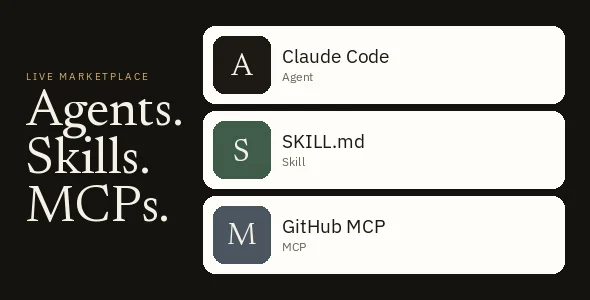
Beacon is a React 19 and TypeScript marketplace application, engineered for developers and agencies to operate a Product Hunt-style ranking platform for AI agents, skills, and MCP servers. The package addresses the operational bottleneck of running discovery directories where ranking integrity, monetization, and editorial control must coexist without paid placement contaminating vote order. In production workflows, it functions as a self-hosted launch desk: hunters rank what they install, makers ship products through a review queue, and operators run advertising, edition weeks, and a staff desk from a single administrative surface.
Technical Specifications & Deployment Matrix
| Engineering Metric | Deployment Specification |
|---|---|
| Base Technology / Framework | React 19 with TypeScript, built on Vite |
| Runtime / Language Requirements | JavaScript (JS, JSON), HTML, CSS; npm-based toolchain |
| Data Exchange / Communication Protocols | TanStack Start, TanStack Router, and TanStack Query for server-state synchronization |
| Front-End / Engine Dependencies | Tailwind v4 styling layer; Better Auth for Google and X sign-in |
| Database / Persistence Footprint | PostgreSQL via PGLite (embedded) or Neon (serverless) |
Ranked Launch Pipeline & Editorial Commerce Engine
The engine ranks every submitted agent, skill, and MCP server through hunter votes and install confirmations, never through paid placement. Maker submissions enter a review queue, where staff approve, edit, or reject entries before they surface in the daily hunt. Approved products then flow into the ranked list, the launch-of-the-day feature slot with its install command, and one of three dedicated directories — Agents, Skills, or MCPs — each carrying its own metadata fields. Hunter accounts attach votes, install marks, and discussion threads to launch pages, while the staff desk exposes catalog CRUD, user management, edition scheduling, notices, ads, calendar slots, and maker records. Advertising is rendered with explicit labeling that reads “Paid · not a rank,” keeping commercial inventory visually and semantically separate from vote order. Edition sponsorship attaches a “presented by” credit to a week without altering ranking state. The calendar module lets makers book upcoming launch days against bookable slots, giving operators forward visibility of the publishing pipeline. For teams researching parallel React-based control surfaces, Crypo exists as a separate dashboard application outside this codebase.
Core Technical Capabilities of Beacon
- Hunter ranking mechanics: Votes and install marks from authenticated accounts drive hunt ordering, so position reflects verified community action instead of ad spend.
- Staff desk CRUD surface: A single administrative module manages catalog records, users, editions, notices, ad placements, calendar slots, and maker profiles.
- Multi-currency revenue book: Every booked deal is tracked through expected, invoiced, and paid states across USD, INR, and EUR.
- Labeled ad inventory: Ad slots occupy the hunt row, directory listings, launch pages, and footer, each flagged as paid content distinct from rank.
- Launch calendar booking: Makers reserve upcoming slots against bookable days, synchronizing the publishing schedule with staff review capacity.
Production Implementation & Operational Resilience
Deployment follows a standard Node workflow: unzip the package, run npm install, then npm run dev to start the dev server. The first signed-in visitor claims the staff desk, so operators should complete that step immediately on a fresh install before opening public registration. Persistence runs on PostgreSQL through two supported modes — PGLite for an embedded, zero-external-database footprint, and Neon for serverless deployments that expect scale-out connection handling. Authentication is handled by Better Auth with Google and X providers, keeping hunter identity verification outside hand-rolled credential logic. The interface ships dual dark and light themes, and layout behavior has been verified at a 390px viewport width, confirming pocket-sized rendering without a separate mobile build. The catalog arrives seeded with a large dataset of real agents, skills, and MCP servers, which shortens the empty-state period after first boot. The live demo exposes the admin desk in read-only mode, so destructive CRUD actions cannot be exercised there; full write behavior is available in a local install. Secondary development is straightforward because the codebase is TypeScript throughout with a Tailwind v4 styling layer, so theme tokens and directory schemas can be extended by editing typed modules. For studios evaluating a multi-vendor commerce model as an independent custom-code path rather than an extension of this architecture, MarketplaceBuddy runs as a separate self-hosted Next.js deployment with its own ledger and checkout logic.
Security Audit & VirusTotal Malware Verification
JavaScriptPre-deployment cloud scan •
67b129f4e73247b4dee09415fa577080a6d4776b70df327b3dfc4a2dacf53401
Frequently Asked Questions
Does the first signed-in visitor automatically gain staff desk control after installation?
Yes. On a fresh local install started with npm run dev, the first visitor who signs in claims the staff desk, so operators should authenticate immediately before opening the platform to public hunter registrations.
Can the application run without provisioning an external database server?
Yes. Persistence supports PGLite as an embedded Postgres mode requiring no external database provisioning, while Neon is available as the serverless alternative for deployments that expect managed, scalable connection handling.
Does the package ship with pre-populated catalog content?
Yes. The catalog includes a large seed of real AI agents, skills, and MCP servers, so the daily hunt, directories, and launch pages render with genuine entries from the first boot instead of empty placeholder states.
Are hunter actions such as voting and install marking available in the live demo?
Yes. The public demo provides hunter credentials that permit voting, marking installs, and commenting, while the staff desk remains read-only there to prevent destructive changes to shared preview data.
-
v1.0 Latest