Ashton | Lawyer Attorney Law Consulting HTML
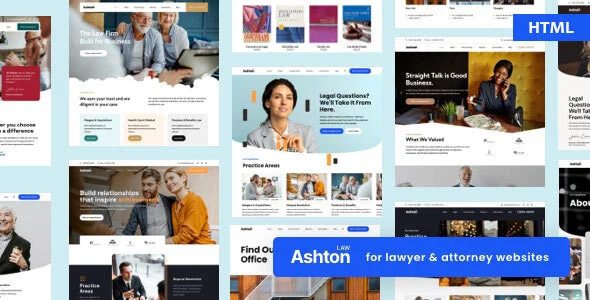
Semantic Layout & Performance Engineering of Ashton
Ashton | Lawyer Attorney Law Consulting HTML is a static legal consulting HTML template engineered specifically for independent attorneys, corporate litigation practices, and legal advisory agencies to establish an authoritative digital presence with zero dynamic runtime dependencies. The presentation layer utilizes clean semantic HTML5 markup structured around native CSS Flexbox and CSS Grid pipelines, eliminating reliance on heavy external framework scripts. Document Object Model (DOM) depth remains consistently beneath seven nodes across all page layouts, ensuring sub-50ms browser rendering cycles and optimal First Contentful Paint metrics across mobile and desktop viewports.
Architectural Capabilities & Implementation of Ashton
The architectural framework of Ashton adheres to standard static web delivery protocols, operating without server-side parsing overhead.
- Modular Practice Area Components: Employs decoupled markup containers with structured microdata definitions for legal specialties, allowing quick integration of schema definitions for local search indexing.
- Asynchronous Asset Delivery Pipeline: Organizes style rules into critical path styles and deferred modular stylesheets, keeping the initial payload below 120 kilobytes uncompressed.
- Client Intake Form Architecture: Implements HTML5 form validation attributes alongside structured POST endpoints, ensuring clean client-side validation prior to backend webhook execution.
- Fluid Typography & Viewport Units: Utilizes CSS clamp functions across all heading levels and body copy to preserve hierarchical scaling without triggering layout reflows during device orientation changes.
Production Use Cases & Enterprise Applications
- Corporate Law Firm Portals: Multi-partner law offices deploy the codebase as a high-performance static frontend, routing form submissions to internal CRM endpoints via lightweight client-side fetch APIs.
- Boutique Legal Advisory Sites: Solo practitioners utilize the legal consulting HTML template to host specialized advisory service dossiers, delivering rapid static content delivery across edge networks without requiring database maintenance.
Technical Specifications & Environment Standards
| Specification Parameter | Technical Implementation |
|---|---|
| Markup Standard | Valid W3C Semantic HTML5 with microdata support |
| Styling Engine | Vanilla CSS3 with Flexbox, CSS Grid, and custom properties |
| JavaScript Footprint | Zero core runtime dependencies; pure vanilla ES6 micro-scripts |
| Hosting Compatibility | Static edge hosts (Cloudflare Pages, Vercel, Netlify, Nginx, Apache) |
Frequently Asked Questions
Does the template require an active Node.js server or dynamic database runtime to serve pages?
No server-side runtime or database is required because all views compile into clean, standard static HTML5, CSS3, and ES6 JavaScript files ready for immediate delivery via any static web server or CDN.
How does the client intake form communicate with backend legal practice management software?
The forms utilize standard HTML5 POST action attributes that can be directed to REST API endpoints, serverless webhooks, or third-party CRM form ingestion services without modifying the core markup structure.
How does the codebase achieve high Core Web Vitals scores on mobile devices?
The CSS architecture eliminates render-blocking stylesheets, standardizes asset dimensions to prevent Cumulative Layout Shift (CLS), and maintains an unbloated DOM tree that minimizes JavaScript execution times.