APPIQ – ONE PAGE App Landing Page Responsive HTML Template
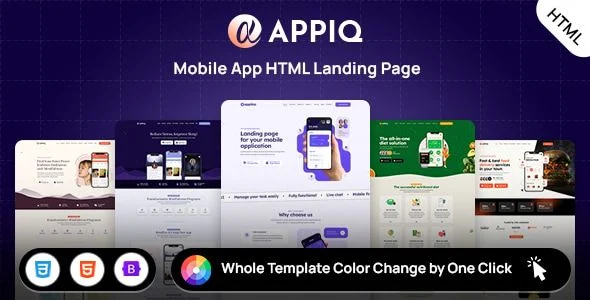
APPIQ App Landing Page Template Overview & Static Front-End Architecture
APPIQ is a Bootstrap 4 responsive HTML template engineered for mobile app publishers, indie developers, and digital agencies to launch conversion-focused landing pages for Food Delivery, Meditation and Mindfulness, Nutrition and Diet, and Fitness applications. The package addresses a recurring front-end bottleneck: producing a polished, multi-variant marketing site without maintaining a server-side stack or a JavaScript build pipeline. In production workflows, it functions as a drop-in static codebase that an agency can deploy to any web host, rebrand, and connect to app store distribution links within a single delivery cycle. Because every page renders directly from prebuilt HTML, CSS, and JavaScript files, there is no database layer, no templating engine, and no runtime compilation between the request and the painted viewport.
Technical Specifications & Deployment Matrix
| Engineering Metric | Deployment Specification |
|---|---|
| Base Framework | Bootstrap 4.x, structured on the 1170px grid system |
| Runtime Requirements | Static hosting only; standard web server (Apache/Nginx) or CDN, no server-side language execution |
| Browser Compatibility | Firefox, Safari, Opera, Chrome, and Edge |
| Front-End Dependencies | Semantic HTML5, CSS, vanilla JavaScript; icofont and flaticon icon sets; Google Fonts (Plus Jakarta Sans, Lexend, Manrope, Elsie) |
| Deliverable Formats | HTML and CSS files, layered PSD (72 DPI, RGB), layered PNG, and a documentation.html customization guide |
| Persistence Footprint | None; fully static presentation layer with zero database or API dependency |
Static Rendering Pipeline & Layout Variant System
The rendering pipeline is browser-driven: the server returns the HTML document, the parser constructs the DOM, the linked stylesheets apply the Bootstrap 4 grid, and the bundled scripts activate interactive components.
The grid enforces column behavior across desktop, laptop, tablet, and mobile viewports through Bootstrap’s native media query breakpoints, so a single stylesheet governs every device class without conditional serving. Layout identity is handled through a variant system rather than duplicated codebases: the multi-page edition ships 11 demos (three default hero configurations, two Food Delivery options, three Meditation options, two Nutrition options, and one Fitness layout), while the one-page edition ships 7 demos covering the same verticals. Hero sections alternate between standard, slider-based, and centered compositions, letting a team select a narrative structure per client without rebuilding section markup. Theming is controlled through a one-click color switch that retints the entire template, replacing the manual task of tracing hex values across multiple stylesheets. HTML and CSS files carry section-level comments, so a developer can locate the exact block governing a pricing table or feature grid and modify it in place.
Architectural & Functional Highlights
- Semantic HTML5 Document Structure: Each demo is composed of well-commented, section-anchored markup, which shortens modification cycles and gives crawlers an explicit content hierarchy for indexing.
- One-Click Global Color Control: A single configuration point retints every component, removing per-element color overrides and reducing the risk of inconsistent brand values across pages.
- Performance-Oriented Asset Strategy: The build is optimized against Google speed insights, relying on lightweight static assets and free Google-hosted web fonts rather than self-hosted font binaries.
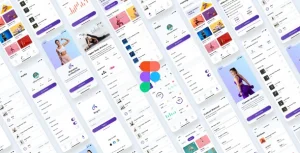
- Editable Design Source Layer: Layered PSD files at 72 DPI in RGB, including smart objects, sit behind the HTML output, so design revisions can be prototyped before any code is touched.
- SEO-Friendly Markup Baseline: The document structure follows search-engine readability conventions, supporting organic visibility for app launch keywords without additional plugin overhead.
Production Implementation & Operational Resilience
Deployment requires nothing beyond copying the file tree to a static host; there are no install routines, migration steps, or environment variables, which makes staging-to-production promotion a pure file transfer. Error surface is correspondingly small: broken layouts almost always trace back to a moved asset path or a deleted font reference, both diagnosable from the commented source. Pre-launch work involves three concrete tasks: replacing the preview stock images, which are licensed for demonstration only and excluded from the download package; updating icon credits for icofont, flaticon, and freepik where required; and wiring the call-to-action buttons to the actual app store listings. Customization boundaries are well defined because the documentation.html file walks through each adjustment, and the layered PSD sources permit pixel-level redesign of any section before it is translated back into markup. Agencies running multi-client pipelines benefit from the variant system: a single purchase covers Food Delivery, Meditation, Nutrition, and Fitness verticals with distinct hero and layout treatments. For product teams whose roadmap later demands a server-rendered marketing stack on React foundations, adopting Aplio as an independent Next.js SaaS landing path keeps that migration decoupled from this static codebase. Similarly, when an app requires an internal operations dashboard after launch, Ultra exists as a separate Bootstrap-based admin theme that runs alongside, not inside, the landing page deployment. Browser testing across the five documented engines should confirm consistent grid behavior before client handover.
Frequently Asked Questions
Are the stock images shown in the demos included in the download package?
No. All stock imagery serves preview purposes only and is excluded from the delivered files, so every production deployment must source and wire its own licensed photography before launch.
Does the package include editable PSD sources for inner pages, not just homepages?
Yes. Beyond nine homepage-level PSDs, the source layer includes inner page designs across multiple versions: About Us (3), Features (3), Pricing (2), Blog list (3), Blog details (3), Contact (3), Sign In (3), and Sign Up (3).