Animals 2048 – Cute Puzzle Game For Kids
Animals 2048 Overview & Game Engine Architecture
Animals 2048 is an HTML5 puzzle game source package, engineered for game studios and indie developers to ship a kid-oriented take on the classic 2048 tile-merge mechanic across browsers and mobile devices. The package addresses a concrete engineering bottleneck: keyboard-driven 2048 implementations rarely translate to touch-first young audiences, so this codebase layers physical key events (W, S, A, D and the four arrow keys) over on-screen button controls inside a single input dispatcher. In production workflows, it operates as a self-hosted web application for desktop and mobile browsers, while a parallel libGDX and Java path carries the same gameplay to native Android and iOS builds through a Gradle build system.
Technical Specifications & Deployment Matrix
| Engineering Metric | Deployment Specification |
|---|---|
| Base Technology / Framework | HTML5 web application (pure front-end runtime) |
| Files Included | JavaScript JS, JavaScript JSON, HTML, CSS |
| Browser Compatibility | Chrome, Edge, Firefox, Safari, Opera |
| Resolution Support | High-resolution assets with responsive layout adaptation across screen sizes |
| Native Export Path | Android and iOS via the libGDX framework and Java |
| Build System | Gradle-based build pipeline for native target compilation |
Grid Merge Mechanics & Execution Pipeline
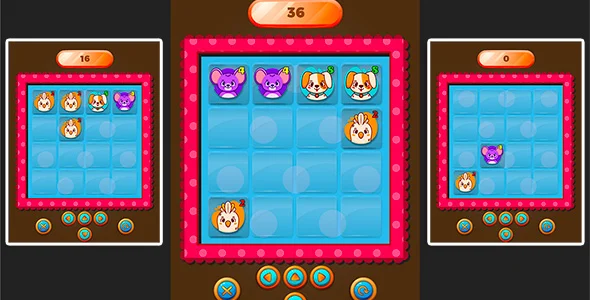
Every validated input event triggers a directional shift across the cell matrix, merging identical animal tiles, accumulating the score and spawning new cells until the 2048 target tile is reached.
Architectural & Functional Highlights
- Dual Input Dispatch Layer: Keyboard listeners (W, S, A, D and arrow keys) and on-screen buttons feed a shared movement handler, so desktop and touch players execute identical grid-shift logic without device-specific code forks.
- Cross-Platform Runtime: The HTML5 build runs across Chrome, Edge, Firefox, Safari and Opera, with a responsive layout that adapts the playfield to varying screen sizes on desktop, Android and iOS browsers.
- libGDX Native Export Path: Beyond the browser, the source exports to native Android and iOS through the libGDX framework and Java, allowing studios to produce store-ready builds from one codebase.
- Gradle Build Pipeline: A Gradle-driven build system handles dependency resolution and packaging for native targets, standardizing the route from source files to compiled release artifacts.
- Commented Source & Documentation: The codebase ships with a high density of inline comments plus written documentation, which shortens onboarding time when developers modify the merge logic or reskin the animal tiles.
Studios assembling a broader browser-game catalog can evaluate Cyber Flap as a separate standalone arcade template for decoupled implementations outside this tile-merge runtime.
Production Deployment & Implementation Considerations
Deploying the web build requires only a static file host: the deliverables consist of JavaScript, JSON, HTML and CSS files with no server-side runtime, database or API dependency, so any shared hosting environment or CDN edge can serve the game. Browser coverage spans Chrome, Edge, Firefox, Safari and Opera on desktop, alongside standard mobile browsers on Android and iOS. Implementation boundaries are defined by the front-end runtime: the package targets puzzle gameplay rather than a back end, and native store deployment is handled through the libGDX and Java export route rather than the web bundle. Customization scope covers the full commented source, giving developers the ability to alter tile art, adjust merge behavior and rework the responsive layout, with the Gradle system managing native rebuilds. For teams planning multi-title releases on separate production tracks, Bundle 10 Games exists as an independent Construct 3 collection built on a different engine.
Frequently Asked Questions
Does the download include the Gradle build configuration required for native Android and iOS compilation?
Yes, the deliverable contains the full source code together with a Gradle-based build system, so the libGDX and Java export route to Android and iOS can be compiled without reconstructing the build pipeline from scratch.
Does the web version require a PHP backend, database or REST API to operate?
No, the browser build runs entirely on JavaScript, JSON, HTML and CSS files, so a static host or CDN is sufficient and no server-side database, authentication layer or API endpoint is needed for gameplay.
Is written documentation included alongside the commented source files?
Yes, the package ships documented source with code comments plus reference documentation covering the build process, which shortens the learning curve when modifying the grid logic or preparing native libGDX builds.