Angry Cube Sticks – Unity Android Game Template
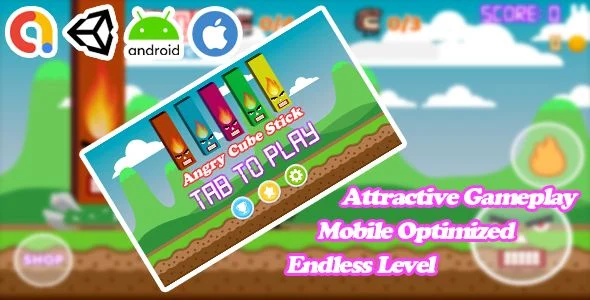
Angry Cube Sticks Overview & Mobile Game Foundation Architecture
Angry Cube Sticks is a Unity 2D survival game template engineered for mobile developers and small studios who need to ship a casual Android title without building core gameplay logic from scratch. The package eliminates the heaviest production bottleneck — authoring a fully connected gameplay economy with enemies, upgrades, quests, and a shop — by supplying pre-written C# controllers that already communicate with each other at runtime. In a typical agency workflow, the codebase functions as a deployable foundation: teams import it into the matching Unity editor, swap the layered PNG art, configure their AdMob identifiers, and produce store-ready builds for Android, iOS, Windows Phone 8, and the web player from a single project.
Technical Specifications & Deployment Matrix
| Engineering Metric | Deployment Specification |
|---|---|
| Base Technology / Framework | Unity game engine, 2D casual survival genre |
| Required Editor Version | Unity 2019.3.15f1 |
| Target Platforms | Android 9.0, iOS, Windows Phone 8, Web Player |
| Monetization Layer | AdMob controller with simplified identifier configuration |
| Source Assets Included | All scripts, all sound files, layered PNG artwork |
| Content Pipeline | Automatic level generation at runtime |
Controller-Driven Gameplay Systems & Execution Pipeline
The architecture routes every gameplay event through discrete controller modules, each owning one subsystem of the game loop. The Game Controller acts as the central coordinator: it initializes the session, requests freshly generated level data from the auto-generation routine, and dispatches state changes to the dependent modules.
During play, the Cube Controller and Enemy Controller manage the opposing sides of the survival loop. The player-controlled cube emits input-driven state transitions, while enemy entities are spawned, tracked, and recycled by their dedicated controller, keeping entity logic isolated from presentation code. When an enemy is defeated or a session milestone is reached, the event propagates to the Quest Controller, which validates progress against its configured objectives and reports completion back to the game state. Currency earned through this loop flows into the Shop Controller, where the Upgrade Controller applies purchased stat modifications to subsequent runs. This separation means each module can be modified in isolation — for example, adjusting upgrade pricing curves without touching enemy spawn logic.
Monetization and content delivery operate as parallel layers rather than gameplay dependencies, so ad identifiers can be reconfigured without recompiling gameplay code. Studios evaluating additional Unity projects for their pipeline can also examine the Word Line – Unity Template Project, which applies a comparable controller-based production approach to the word-puzzle genre as an independent codebase.
Architectural & Functional Highlights
- Automatic Level Generation: Levels are constructed procedurally at runtime rather than hand-placed, which removes per-level authoring cost and produces variability across play sessions without additional scene assets.
- Integrated Economy Controllers: Shop, Upgrade, and Quest controllers form a closed progression loop — quest rewards feed currency, currency funds upgrades, and upgrades modify cube behavior in later runs.
- AdMob Controller with Simplified Setup: Ad unit identifiers are isolated inside a dedicated controller, reducing monetization configuration to identifier replacement instead of SDK plumbing across multiple scripts.
- Mobile Performance Optimization: The codebase is tuned for mobile hardware budgets, targeting stable frame delivery on Android 9.0-class devices and cross-build compatibility with iOS, Windows Phone 8, and web player targets.
- Complete Asset Delivery: All scripts, all sound files, and layered PNG art ship with the package, giving artists direct access to separable image layers for re-theming.
Production Implementation & Operational Resilience
Deployment begins in Unity 2019.3.15f1 — matching this editor version is a prerequisite, since opening the project in a mismatched Unity release can trigger script API recompilation or asset serialization warnings that the original package was never validated against. Once imported, the recommended staging sequence is to build the unmodified Android package first, verify the gameplay loop on a physical device, and only then begin art replacement and AdMob identifier configuration, so any runtime regression can be attributed to a single change set.
Customization operates primarily at the asset and configuration layers. Because the artwork ships as layered PNG files, re-theming is achieved by editing individual layers in an image editor and re-exporting, without modifying the render logic that consumes the sprites. Tuning gameplay economy parameters — upgrade costs, quest thresholds, enemy behavior values — happens through the exposed controller settings rather than by rewriting the dispatch logic that connects them. Teams should budget device-level testing across all four supported build targets before store submission, since each platform runtime carries its own input and rendering characteristics. For developers seeking a comparable mobile foundation in a different genre, the Unity Game Template – Highway Surfer provides an endless-runner codebase as a separate standalone project outside this package.
Frequently Asked Questions
Do I need a specific Unity editor version to open the project correctly?
Yes, the package was authored and validated in Unity 2019.3.15f1, and building against that exact editor version avoids recompilation errors, serialized asset mismatches, and script API differences that can appear when a different Unity release is used.
Are the source scripts, sounds, and editable artwork all included in the download?
Yes, the delivery contains every gameplay script, the complete sound set, and all art assets as layered PNG files, so both the code layer and the visual layer can be modified directly without recreating or sourcing external assets.
Can production builds target platforms other than Android?
Yes, the project supports compilation to Android, iOS, Windows Phone 8, and the web player, allowing a single codebase to feed multiple distribution channels although each target still requires its own platform-specific build testing.
Are levels pre-designed or generated by the engine at runtime?
No, levels are not hand-authored. The template auto-generates level content during execution, which reduces content production effort and introduces structural variation between sessions while the Game Controller coordinates how generated data feeds the active gameplay loop.