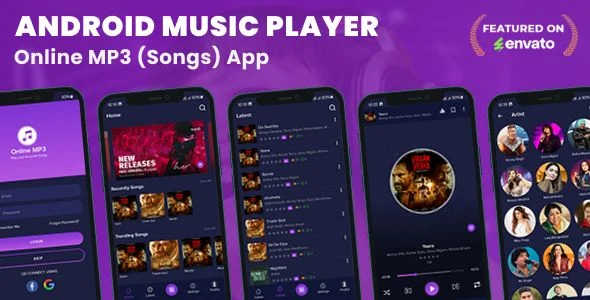
Android Music Player – Online MP3 (Songs) App
Android Music Player Overview & Server-Authoritative Streaming Architecture
Android Music Player is a native Android source code package paired with a PHP and MySQL admin panel, engineered for artists, record labels, and app developers to operate a self-hosted online MP3 streaming service. It removes the dependency on third-party distributors by giving the operator direct control over tracks, albums, artist profiles, and genre taxonomies from a single backend dashboard. Within a production delivery workflow, the codebase functions as the deployable mobile client that consumes a server-managed audio library and publishes it to listeners under the operator’s own brand.
Technical Specifications & Deployment Matrix
| Engineering Metric | Deployment Specification |
|---|---|
| Base Technology / Framework | Native Android client built on Material Design UI conventions; PHP + MySQL server backend |
| Runtime / Language Requirements | Android OS device for the client; PHP and MySQL-capable web hosting for the admin layer |
| Data Exchange / Communication Protocols | HTTP requests carrying JSON payloads between the client and the admin-driven content API |
| Front-End / Engine Dependencies | Android SDK build toolchain for APK compilation, signing, and store release configuration |
| Database / Persistence Footprint | MySQL schema storing tracks, albums, artists, and categories; on-device downloads for offline playback |
Content Delivery Architecture & Execution Pipeline
Content delivery follows a server-authoritative pipeline: the PHP admin panel publishes library data that the Android client consumes over JSON. An operator signs into the backend dashboard, uploads audio files, and structures them into albums, artist profiles, and genre or category taxonomies; every write operation lands in the MySQL schema that serves as the single source of truth for the catalog. The mobile client requests catalog state through HTTP calls, deserializes the JSON responses into its Material Design list views, and renders playable tracks without manual client-side content edits.
Playback events are handled natively: audio sessions continue during background execution, and lock screen controls expose transport actions to the Android system UI. Search queries run against the server dataset rather than a bundled index, so results reflect the current library at query time. A Firebase integration dispatches push notifications from the administrative side to active installations, letting operators announce releases without republishing the APK. For teams evaluating a playback experience with no server-side content layer at all, Offline Music App – Mp3 Soundboard exists as an independent mobile build oriented around local soundboard playback.
Core Technical Capabilities of Android Music Player
- Firebase Push Notification Pipeline: The client registers with Firebase messaging and receives admin-triggered broadcasts, enabling release announcements and re-engagement messages delivered through device-level notification channels.
- Dual-Format AdMob Monetization: Banner and interstitial ad units are pre-wired into the layout and navigation flow, so revenue generation activates once the operator supplies their own AdMob unit identifiers during configuration.
- Offline Playback via Local Downloads: Users persist selected songs to device storage, decoupling listening sessions from network availability while the server catalog remains authoritative for streamed content.
- Material Design Playback Surface: Browsing, player, equalizer, and profile screens apply Google’s Material Design system, with background playback and lock screen controls handled through native audio session management.
Production Implementation & Operational Resilience
Deployment requires two coordinated environments: a web host running PHP and MySQL for the admin panel, and an Android SDK build setup for compiling, signing, and publishing the client APK. Store release configuration involves binding the project to a Firebase console for messaging, inserting AdMob unit identifiers, and replacing launcher assets and application identifiers with the operator’s brand values before generating a signed release build.
Operationally, the architecture has a defined boundary: streaming and catalog browsing depend on backend availability, so online playback inherits the uptime of the hosting environment, while previously downloaded tracks remain playable without connectivity. Library edits pushed through the dashboard propagate to clients on their next catalog request, keeping content refresh cycles independent of application updates pushed through the store.
Secondary development targets the standard Android customization surfaces: reskinning layout resources, adjusting Material Design styling, and extending the admin-defined taxonomies. For studios weighing AdMob monetization patterns across separate Android deployments, Word Search (Admob + GDPR + Android Studio) demonstrates a parallel ad-configured template in the puzzle domain, useful as a reference for multi-app release strategies.
Frequently Asked Questions
Can users control playback from the Android lock screen while the app runs in the background?
Yes, background playback and lock screen controls are documented features, meaning transport actions stay available through the Android system UI even when the application is not the active foreground task on the listener’s device.
Does managing the music library through the admin panel require programming knowledge?
No, the dashboard is designed for content updates without coding skills, allowing operators to upload tracks, restructure albums, and edit artist profiles in real time through form-based controls rather than direct database statements.
Are built-in user profiles part of the client feature set?
Yes, the application ships with detailed user profiles, giving each listener an in-app identity where account data and preferences can be associated with their listening activity across sessions.
Can the package power a niche online radio station concept rather than a standard song catalog?
Yes, the source context positions the app for enthusiasts building niche streaming services, and because the admin panel governs the full track list, an operator can curate a continuous rotation of audio under one branded channel.
2 App Template | Online Poker | Multiplayer Card Games | Casino| Online Card Game | PokerKing
Music Player – MP3 Player – Audio Player – Play Music – Android App – Admob Ads – Lite Player
Pre-Wedding Music Video Editor | Pre-Wedding Slideshow Video Maker | Android | Admob Ads