Android AI Voice Call Dialer
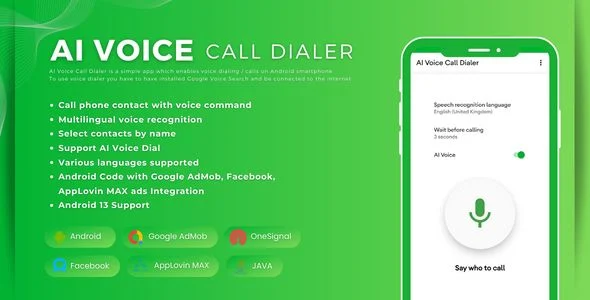
Android AI Voice Call Dialer Overview & Native Voice Command Architecture
Android AI Voice Call Dialer is a native JAVA and XML Android application source package, engineered for mobile developers and app publishers to ship a voice-command contact dialing product without engineering speech-recognition logic from scratch. The package resolves a specific architectural bottleneck: wiring Android telephony intents to a speech pipeline by routing a spoken contact name through Google Voice Search and a third-party free voice API, then matching the returned transcript against the device contact list before dispatching the call. Within agency and studio delivery workflows, it operates as a ready-to-compile, rebrandable codebase that ships with AdMob and Facebook ad placements already wired into the monetization layer.
Technical Specifications & Deployment Matrix
| Engineering Metric | Deployment Specification |
|---|---|
| Base Technology / Framework | Native Android: JAVA application logic, XML layouts with Material Components |
| Runtime / SDK Requirements | Minimum SDK API 28 (Android 9.0); Target SDK API 36 (Android 16); verified device range Android 9.0–15.0 |
| Speech Engine / Communication | Google Voice Search integration plus third-party free voice API services over an active internet connection |
| Front-End / Engine Dependencies | Material Components library; microphone and contacts runtime permissions; Google Voice Search installed on device |
| Database / Persistence Footprint | No database layer; contact lookups execute in-memory and no user data is collected or stored |
| Monetization Layer | AdMob and Facebook ad SDK integrations |
| Deliverable Files | .apk binary, .java sources, .xml layouts |
Speech-to-Call Execution Pipeline
The execution pipeline converts a spoken contact name into a dispatched phone call through four sequential stages: audio capture, transcription, contact resolution, and intent dispatch.
When the main activity starts, the module requests the microphone permission and begins capturing the user’s spoken command. The audio is handed to Google Voice Search, which communicates with a third-party free voice API to produce a text transcript — a server-side step that makes a live network connection a hard runtime requirement. The transcript is then matched against entries in the device contact list, a lookup gated by the contacts permission. Once a name resolves to a number, the engine forwards it to Android’s native dialer as a call intent, and the handset dials without any keypad interaction. Text-to-speech output can read the resolved contact back to the user before the call connects. Recognition input and speech output operate in English, Hindi, German, French, Spanish, Italian, Portuguese, Russian, Chinese, Gujarati, and additional languages, so localized builds require no re-engineering of the input layer.
This single-purpose delivery pattern — one focused utility layered over platform services — parallels other native Android utilities in production, such as Infinity Radio, which likewise wraps AdMob, OneSignal, and Firebase services inside a focused native shell.
Core Technical Capabilities of Android AI Voice Call Dialer
- Voice-Command Contact Resolution: The matching layer compares the returned transcript against on-device contacts and passes the resolved number to the native dialer through a call intent, removing manual dialing from the interaction path.
- Multilingual Recognition and Speech Output: Voice recognition input and text-to-speech output cover eleven-plus languages, letting publishers target regional markets without rewriting the recognition layer.
- Scoped Runtime Permission Model: Only the contacts permission (name-to-number lookup) and the microphone permission (audio capture) are requested; no storage, location, or account scopes are declared.
- Dual Ad Network Integration: AdMob and Facebook placements are already wired into the JAVA layer, so either network’s inventory can be attached to the dialing flow without manual SDK wiring.
- Modern SDK Compliance: The build targets API 36 (Android 16) with a minimum of API 28 (Android 9.0), keeping release binaries aligned with current store submission requirements.
Production Implementation & Operational Resilience
Deployment begins by importing the .java and .xml sources into Android Studio, where Material Components govern theming and layout tokens. Because the persistence footprint is zero — no database writes, no stored recordings — client staging carries no data-retention exposure, which simplifies privacy review documentation for store submission.
Error boundaries are explicit and testable. When no contact matches the transcript, the flow halts before any call intent is dispatched. When connectivity drops or Google Voice Search is not installed on the device, transcription cannot complete, so QA teams should stage flight-mode and de-googled device tests before client handoff. Because the voice API operates as a free third-party service, its availability and throughput sit outside the application’s control — a boundary worth documenting in any client-facing SLA.
For secondary development, the XML layouts can be restyled through Material Components tokens, ad unit identifiers swapped in the configuration classes, and default recognition languages adjusted in the JAVA layer. For teams evaluating separate standalone Android monetization projects outside voice telephony, The Holy Quran v1 provides an independent full-source reference built on the same AdMob-plus-Firebase monetization stack.
Frequently Asked Questions
Does the application store voice recordings or contact data on any server?
No. The package contains no persistence layer; audio captured for recognition is processed by the external API for transcription only, and the documentation explicitly states that user data is neither collected nor stored in any type of database.
Can voice dialing operate without an active internet connection?
No. Speech recognition is delegated to Google Voice Search and a third-party free voice API, so a live network connection is a mandatory runtime condition; offline transcription and offline voice dialing are not supported by this architecture.
Does the deliverable bundle include a compiled APK alongside the source files?
Yes. The package ships an .apk binary together with the raw .java and .xml files, allowing immediate on-device testing of the stock build before any source-level modification or recompilation is performed.
Are Facebook ad placements supported in addition to AdMob?
Yes. Both AdMob and Facebook ad integrations ship inside the codebase, so publishers can configure either network’s placements within the dialing flow without adding the underlying SDK wiring manually.
SangitGuru – Music Player, Ringtone Maker, Voice Recorder & Radio Streaming Android App

Janu – Dating App : Live Streaming App : One to One Video Calling App (Fake Users)

Fake Call | Fake Video Call | Dialogflow Message | Auto Message Bot System| Android App |Admob| V3.2