Alleora – Wedding Organizer Elementor Template Kit
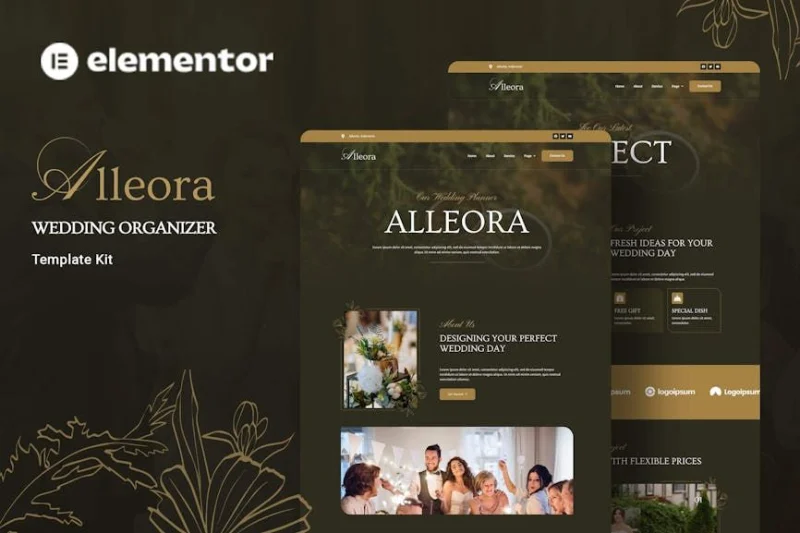
Alleora Wedding Organizer Template Kit Overview & Layout Architecture
Alleora is an Elementor Template Kit built for wedding planners, event coordinators, and bridal consultants who need a complete, code-free website layout system. It removes the bottleneck of hand-assembling a multi-page design — type scales, soft palettes, responsive containers — by shipping pre-structured JSON templates that import directly into the Elementor Pro editor. In production workflows, agencies treat it as a deployable layout foundation: import the kit, rebrand through global styles, then swap in each client’s services, portfolio, and copy.
Technical Specifications & Deployment Matrix
| Engineering Metric | Deployment Specification |
|---|---|
| Base Technology / Framework | WordPress running the Elementor Pro page builder; template kit distribution format |
| Runtime / Language Requirements | Standard WordPress hosting; wp_memory_limit raised to 128 MB or higher is recommended before kit import |
| Data Exchange / Communication Protocols | JSON layout definitions processed through the Elementor kit import routine |
| Front-End / Engine Dependencies | Elementor Pro widgets and the Site Settings global styles system for colors and typography |
| Database / Persistence Footprint | None at kit level; imported layouts persist as editable page documents, with no custom database schema shipped |
Design Token System & Template Rendering Pipeline
The kit operates on a token-driven rendering model in which every page binds its colors and typography to one global styles definition. During installation, the Elementor import routine parses each JSON template file, reconstructs its container tree on the editor canvas, and registers the referenced assets — imagery, icons, and font assignments — into the site settings and media layers. Because each layout resolves its palette and type scale against global tokens rather than local widget values, a single edit inside Site Settings propagates across every imported page, which matters when rebranding one master installation for multiple bridal clients.
The visual system follows a modern-romance direction: restrained vertical rhythm, soft color palettes, and typographic hierarchy that moves visitors from service listings through portfolio galleries toward the contact page. Composition relies on nested Flexbox containers rather than legacy section-and-column stacks, keeping the rendered DOM shallow and reflow behavior predictable at tablet and mobile widths.
Architectural & Functional Highlights
- Global styles tokenization: Colors, font families, and type scales resolve from one Site Settings definition, so a palette change re-skins the homepage, services, portfolio, and blog layouts without per-page edits.
- Flexbox container architecture: Pages assemble from nested containers, which shortens DOM depth relative to legacy column models and keeps element reflow deterministic across registered breakpoints.
- Complete page inventory: The package ships more than 10 templates covering homepage, about, services, portfolio, pricing tables, FAQ, testimonials, blog, and contact — enough surface area for a full wedding-planning brand site.
- Responsive by construction: Container-based layouts reflow automatically at Elementor’s breakpoints, so mobile rendering requires no duplicated per-device page variants.
For agencies that prefer a full theme runtime with native invitation and RSVP components rather than kit-based page assembly, Bissful Wedding & Event WordPress Theme operates as an independent alternative outside the Elementor kit workflow, packaging schedules and memories in a self-contained layout system.
Production Implementation & Operational Resilience
In agency staging environments, import the kit on a clean WordPress installation running a current Elementor Pro version before populating client content. The heaviest operation is the initial JSON import; hosts capping wp_memory_limit at 64 MB can abort mid-import on larger templates, so raising the limit to 128 MB or 256 MB beforehand avoids truncated layouts. When a single template fails, the importer allows retrying that page individually rather than repeating the full set.
Because the kit is a static layout package, its customization boundaries stay narrow: teams override styles through global tokens, replace images and copy inside the editor, and restructure containers visually. There are no action hooks, PHP template files, or backend endpoints to extend, and no server-side validation logic to adapt. Error handling therefore lives at the platform layer — Elementor surfaces import conflicts such as missing widgets from an inactive Pro installation or unsupported JSON versions, while the kit itself ships no fallback logic of its own.
Studios benchmarking adjacent wedding-sector assets can also evaluate Hibride Bridal Photography & Wedding Planner Elementor Template Kit, which occupies a parallel position in the same Elementor runtime with a focus on bridal photography portfolios.
Frequently Asked Questions
Does Alleora require Elementor Pro to import and render its templates?
Yes. The kit is built for Elementor Pro, and its global styles system plus several widget structures depend on the Pro runtime. Importing into a free-only Elementor installation will produce incomplete or broken layouts.
Does the package include a WordPress theme, plugin, or any PHP files?
No. The deliverable is a set of Elementor template definitions processed through the page builder’s import routine; the package ships no theme files, plugins, or server-side code alongside its JSON layouts.
Is coding knowledge required to deploy and customize the kit?
No. All modifications happen inside the Elementor editor — replacing imagery, editing copy, and adjusting tokens through Site Settings — so a wedding planning business can launch and maintain its site without touching HTML, CSS, or PHP.