All In One Dynamic News Papers (Supported android 14 and SDK 34)
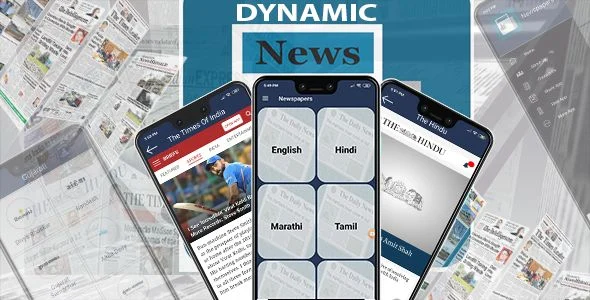
All In One Dynamic News Papers Overview & Multi-Language Aggregation Architecture
All In One Dynamic News Papers is a native Android application source code, engineered for mobile developers and agencies to deploy a multi-language newspaper aggregation product across twelve Indian languages. The package removes the operational bottleneck of installing dozens of separate publication apps by routing every supported outlet — from The Times of India and Dainik Bhaskar to Manorama Online and Sakshi — through a single directory-driven interface. Within agency delivery pipelines, it operates as a reskinnable, dual-network monetization-ready codebase that publishes directly to Google Play without any backend server dependency.
Technical Specifications & Deployment Matrix
| Engineering Metric | Deployment Specification |
|---|---|
| Base Technology / Framework | Native Android application, developed in Android Studio |
| Runtime / Language Requirements | Android 5.0 and later; validated through Android 14 with target API level 34 (SDK 34) |
| Data Exchange / Communication | Live newspaper websites rendered through the in-app browsing layer; supports all website types |
| Monetization / Engine Dependencies | Google AdMob and Facebook ad placements (banner and interstitial) |
| Database / Persistence Footprint | None — fully serverless; no hosting, database, or admin panel required |
| Deliverables | Full source code, documentation, demonstration APK, and screenshot designs |
Directory-Driven News Delivery & Monetization Pipeline
The core mechanism is a language-partitioned publication directory that resolves each entry to its live web edition inside a unified reading shell. When a user selects one of the twelve supported languages — English, Hindi, Marathi, Tamil, Assamese, Kannada, Oriya, Telugu, Gujarati, Malayalam, Punjabi, or Urdu — the interface dispatches a filtered publication list, and the chosen outlet loads directly within the application rather than redirecting to an external browser. Because the engine accepts all website types, operators can extend the catalog with regional, national, or niche outlets without touching native view logic. The audience positioning spans students, business professionals, NRI readers, and entrepreneurs tracking daily politics, sports, business, and entertainment headlines.
Monetization runs in parallel with content delivery. Banner units occupy persistent placement positions while interstitial units fire at defined transition points, both wired through the AdMob and Facebook SDK configuration layers. For studios pursuing parallel mobile verticals that apply the same dual-banner and interstitial pattern to image-gallery distribution, Wallpapers Android App – Admob Ready follows an equivalent monetization model on the native Android stack.
Architectural & Functional Highlights
- Twelve-Language Publication Catalog: Ships with pre-populated lists across English, Hindi, Marathi, Tamil, Assamese, Kannada, Oriya, Telugu, Gujarati, Malayalam, Punjabi, and Urdu, covering major outlets such as The Hindu, Jagran, Prajavani, Sambad, and Manorama Online.
- Dual Ad Network Support: AdMob and Facebook banner and interstitial placements are both configured in the codebase, letting operators switch or split revenue sources by editing identifier values alone.
- Serverless Operation: No server, database, or admin panel exists in the architecture; publication entries and configuration live inside the app package, keeping hosting costs at zero.
- Engagement Utilities: Built-in Share App, Rate App, More App, and Contact modules drive store rankings and cross-promotion without additional libraries.
- Reskin-Friendly Structure: Logo, splash screen, app name, package name, and ad identifiers are isolated as replaceable assets, allowing full rebranding before Play Store submission.
Production Implementation & Operational Resilience
Deployment follows a deterministic reskin checklist: replace the launcher logo and splash artwork, rename the application, update the package name, insert your own AdMob identifiers, and generate a signed release build for Play Store distribution. The Android 14 and SDK 34 alignment satisfies current store target-API expectations, and the release history demonstrates continued maintenance — Android 10 support arrived in September 2020, Android 11 and SDK 30 in September 2021, followed by design improvements, bug fixes, and the SDK 34 update. Phone and tablet layouts are both supported from a single codebase.
Operational boundaries worth planning for: the package ships with freely available images, and verification of image and publication ownership rests with the deploying operator, so an asset audit before launch is prudent. Since the reading layer loads live websites, content availability depends on each publisher’s site stability rather than on any local cache. Studios assembling a broader multi-app portfolio can treat this package as one standalone native codebase path, comparable in delivery model to Wall Hub – Android Wallpapers App on the same Android runtime. Secondary development is limited to directory entries, theming, and asset replacement; no server-side extension points exist because none are needed.
Frequently Asked Questions
Is a demonstration APK included so the app can be tested before compiling the source?
Yes, the package ships with a demonstration APK containing AdMob ads, allowing QA teams to evaluate the reading experience, language switching, and ad placement behavior on real hardware before any Android Studio build.
Can Facebook ad placements serve alongside AdMob within the same build?
Yes, the codebase implements both networks with banner and interstitial formats, so operators can populate either set of identifiers or run both depending on their monetization strategy.
Is a backend server, database, or admin panel required to operate the publication catalog?
No, the architecture is fully serverless. Publication entries, language grouping, and configuration are contained inside the app package, which means zero recurring hosting overhead and no server maintenance obligations.
Which deliverables are included with the package?
Buyers receive the full source code, the documentation, the demonstration APK, and the designs shown in the screenshots, providing everything needed to reskin, build, and publish independently in Android Studio.
Blogging App | WordPress News App| WordPress Blog App | Koowoo
Blogging App | Blog App | WordPress News App | WordPress Blog App | Boomer App
SpotiDown – Spotify Audios, Videos, Canvas Downloader | ADMOB, FAN, APPLOVIN, FIREBASE, ONESIGNAL