Agrimo – Agriculture Organic Farm WordPress Theme
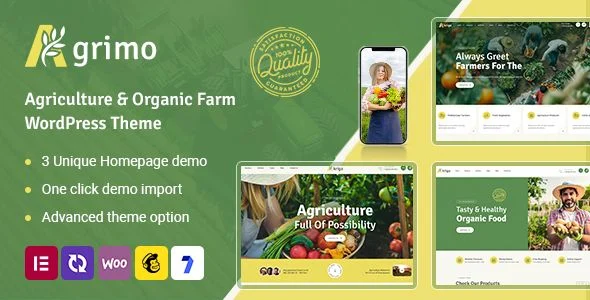
Agrimo Agriculture Organic Farm WordPress Theme Overview & Turnkey Organic Commerce Foundation
Agrimo Agriculture Organic Farm WordPress Theme is an Elementor-driven WordPress theme package, engineered for agencies and site builders delivering digital storefronts for farms, fruit shops, dairy operations, and organic markets. It removes the layout-assembly bottleneck that slows agricultural eCommerce projects by shipping 15 prebuilt homepage layouts, bundled Slider Revolution assets, and a guided demo-content installation wizard on a Bootstrap 5.x grid. Within production workflows, the package operates as a turnkey presentation and commerce layer that renders responsive, widget-ready pages across WooCommerce 8.x through 10.x store environments.
Technical Specifications & Deployment Matrix
| Engineering Metric | Deployment Specification |
|---|---|
| Base Technology / Framework | WordPress 6.7.x – 7.0.x, Bootstrap 5.x, Elementor Page Builder |
| Runtime / Language Requirements | PHP 7.4 through PHP 8.4.x; delivered as PHP, CSS, and JS source files |
| Data Exchange / Communication Protocols | WooCommerce 8.x – 10.x storefront layer, WPML translation streams, Contact Form 7 form handlers |
| Front-End / Engine Dependencies | Elementor editor, Slider Revolution (v6.7.58), custom theme widgets |
| Database / Persistence Footprint | Native WordPress MySQL schema via Customizer options with live preview, widget sidebars, and demo-content import records |
Elementor-Driven Rendering & Storefront Execution Pipeline
Agrimo routes every frontend page through the Elementor page builder engine, where widget and container trees are serialized and rendered inside the standard WordPress template hierarchy.
Inbound requests resolve against theme templates that read configuration from two synchronized sources: the Customizer options panel with live preview, and Elementor’s per-page layout data. The demo-content wizard automates initial state by importing pages, posts, and widget assignments so a staging site reaches a production-adjacent appearance in one guided pass. Commerce requests flow through the WooCommerce layer, where cart quantity and price recalculate via AJAX without full page reloads — a behavior patched in the v1.1 and v1.3 releases to keep the header cart total synchronized. For multilingual deployments, WPML compatibility extends into Advanced Custom Fields meta fields as of v1.7, letting translators manage structured farm-product data inside one translation workflow; when storefronts additionally require multicurrency checkout across locales, WooCommerce Multilingual & Multicurrency with WPML Proven operates as the complementary commerce-translation layer on the same runtime.
Core Technical Capabilities of Agrimo
- Demo Content Wizard: a guided import writes page structures, menu assignments, and widget sidebars into the WordPress database, eliminating the manual template-assembly phase of deployment.
- Dual Configuration Surfaces: the Customizer live-preview panel and the Elementor editor both persist settings, splitting global typography, color, and layout control from per-page composition without PHP edits.
- WooCommerce Storefront Synchronization: AJAX handlers update cart quantities and header totals in place, while WooCommerce page templates were re-verified during the v1.5 and v1.6 compatibility passes against the current plugin release line.
- Custom Post Type Elements: CPT elements accept ajax sortable category ordering, so produce collections and product grids are rearranged through a sortable interface rather than manual query editing.
- SVG Asset Support: added in v1.1, SVG uploads allow logo and iconography pipelines to ship vector graphics directly into the media library.
Production Implementation & Operational Resilience
Deployment targets span PHP 7.4 through 8.4.x and WordPress 6.7.x through 7.0.x, giving agencies latitude across legacy and current hosting stacks. The codebase ships as readable PHP, CSS, and JS files, so asset minification, caching, and CDN offloading remain under the hosting stack’s control rather than being locked into the render path. GDPR readiness is documented at the theme level, positioning the package for EU-facing farm and food-retail launches. Mobile rendering is reinforced by the sticky-header-on-mobile toggle introduced in v1.4 and by browser dash-bar color synchronization with the theme’s global palette, handled in v1.3.
Defect handling has been iteratively hardened across the release history: v1.7 resolved an undefined-variable warning in the Spinner Box element and cleared a Lighthouse accessibility flag for links without descriptive text, while v1.6 corrected empty search-term handling so undefined queries land on a valid results template. A child theme ships inside the package, making template and function overrides the sanctioned customization boundary that survives parent-theme updates. POT language files are updated on a recurring cadence, keeping translation pipelines current. For teams scoping parallel organic-retail theme options on the same WordPress runtime, Bottanika Pro represents an independent organic food store implementation with its own demo-import and WooCommerce integration path.
Frequently Asked Questions
Is Agrimo optimized for the Gutenberg block editor?
No. The theme’s page-building pipeline is built around the Elementor Page Builder, and Gutenberg optimization is explicitly not a supported target. Content production should be planned through Elementor’s editor rather than native block patterns.
Are the images shown in the live demo included in the download package?
No. Demo imagery is licensed separately and excluded from both the download package and the demo-content data. Imports substitute free images or placeholders, so production sites must source their own photography before launch.
Can the sticky header be enabled on mobile viewports?
Yes. A dedicated option introduced in the v1.4 release activates the sticky header on mobile devices alongside existing desktop behavior, requiring no custom CSS overrides in the shipped child theme.