Admin.io – Responsive Material Design Dashboard
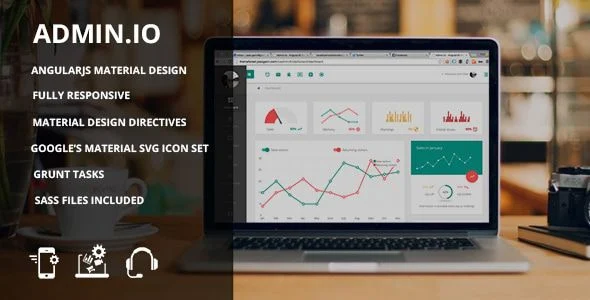
Admin.io Overview & Responsive Material Design Admin Architecture
Admin.io is a responsive AngularJS admin dashboard template, engineered for front-end developers and product teams to deliver material design administration interfaces on top of Google’s angular-material framework. It removes the assembly burden of constructing back-office panels from scratch by packaging custom AngularJS services and directives, an SVG icon set, modular SCSS, and a Grunt plus Bower build pipeline into a single source distribution. Within agency delivery and production workflows it operates as a self-hosted HTML, CSS, and JavaScript package for composing dashboards, analytics views, task managers, and user profile pages.
Technical Specifications & Deployment Matrix
| Engineering Metric | Deployment Specification |
|---|---|
| Base Framework | AngularJS (updated to 1.5.8) with Google’s angular-material component framework |
| Runtime / Language Requirements | Client-side JavaScript; any static web server capable of serving HTML, CSS, and JS assets |
| UI Component Layer | angular-material directives combined with Bootstrap UI (angular-ui bootstrap) components |
| Build & Dependency Tooling | Grunt task runner with SCSS compilation; Bower front-end dependency management |
| Visualization Libraries | Chart.js, Morris.js, Flot Charts, Sparkline, and gauge chart modules |
| Browser Compatibility | IE9, IE10, IE11, Firefox, Safari, Opera, Chrome; responsive 4+ column layout |
| Persistence Footprint | None bundled — no backend or database layer; all data flows through client-side AngularJS scopes |
AngularJS Data-Binding Pipeline & Material Component Execution
Admin.io executes as a client-side AngularJS application where material directives render bound scope data. On bootstrap, the AngularJS module loads the dashboard shell, angular-material directives construct the layout hierarchy, and the template’s custom services and directives attach application-specific behavior to each view. Inbound data assigned to scope variables propagates through the digest cycle into the charting layer, where Chart.js, Morris, Flot, Sparkline, and gauge wrappers translate raw values into rendered visualizations; a documented update ensures gauge charts redraw automatically whenever their underlying data changes.
The styling layer follows a modular SCSS organization: partials are separated per component concern, Grunt tasks compile the stylesheets into deployable CSS, and Bower resolves front-end library versions so dependency drift between environments stays controlled. Form behavior leans on Bootstrap UI components for validation and customization, while navigation, scrollable panels, modals, and FAB buttons draw from the angular-material directive inventory, including chips and contact chips components added in later releases.
For teams standardizing on a React 19 runtime rather than AngularJS, Tailux exists as an independent admin dashboard package on a separate technology stack — the two codebases target different frameworks and cannot be merged into a single build.
Core Technical Capabilities of Admin.io
- Material Design directive layer: Google’s angular-material framework supplies layout primitives, chips, contact chips, and FAB button components, extended with the template’s own custom AngularJS services and directives for application-level behavior.
- Multi-library charting stack: Chart.js, Morris.js, Flot Charts, Sparkline, and gauge chart modules render from bound scope data, with documented maintenance ensuring gauge visualizations respond automatically to data mutations.
- SCSS, Grunt, and Bower build pipeline: styles are organized into structured SCSS files, Grunt automates compilation and asset processing, and Bower governs front-end dependency resolution across development and staging environments.
- Embedded utility modules: Google Maps and vector map views, toastr notification handling, scrollable panels, modals, weather widgets, a task manager, and a personal profile page ship as pre-built templates ready for scope wiring.
- Scalable SVG icon system: an included SVG icon set renders resolution-independent glyphs, avoiding bitmap sprite degradation on high-density displays.
Production Implementation & Operational Resilience
Because Admin.io ships as static HTML, CSS, and JS files, deployment reduces to serving the compiled asset bundle from any web host — no server runtime, database provisioning, or server-side configuration is required. The recommended workflow runs Bower to install front-end dependencies and Grunt to compile the SCSS layer before promoting assets to staging or production, keeping style changes reproducible across environments.
Thematically, a documented March 2015 update introduced pre-made color options and restructured the palette around a clear primary and accent color pair per Google’s material color guidance, so rebranding for a client engagement happens at the variable level rather than through scattered selector edits. Operational hardening is visible in the maintenance history: a Nexus 5 navigation defect was patched, a double-click event firing on mobile devices was corrected, a Flot Charts tooltip issue was resolved, an IE9 bug was fixed, the underscore library issue was addressed, and AngularJS was upgraded through version 1.5.8 with theme dependencies refreshed to current releases.
The operational boundary is explicit: every chart, map, and notification module expects data injected through client-side AngularJS bindings, so backend API contracts and persistence must be engineered by the implementing team. For a parallel material design admin interface that does not depend on the AngularJS runtime, Alpha stands as a separate standalone template option outside this stack.
Frequently Asked Questions
Does the Admin.io package ship with server-side code or database files?
No. The deliverable contains HTML, CSS, and JS files only, built on the AngularJS runtime. All data sources, API endpoints, and persistence layers must be wired into the client-side application by the implementing developer.
Can the color scheme be reconfigured without editing every SCSS partial?
Yes. A 2015 update introduced pre-made color options and restructured theming around a primary and accent color pair following Google’s material palette guidance, so palette swaps reduce to variable-level changes rather than per-partial edits.
Does the template support Internet Explorer 9?
Yes. IE9 is listed among the supported browsers, and a documented August 2015 update specifically patched an IE9 rendering defect. AngularJS was also upgraded to version 1.5.8 in a later maintenance release.