Acens – Creative Agencies WordPress Theme
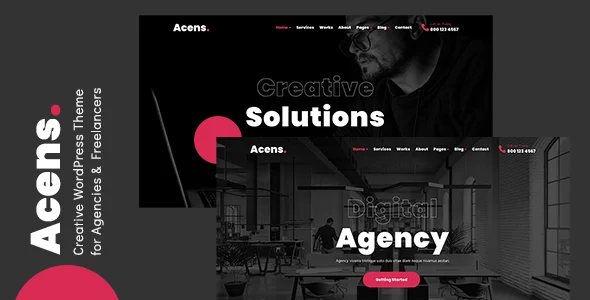
Acens Creative Agencies WordPress Theme Overview & Front-End Delivery Engine
Acens Creative Agencies WordPress Theme is an Elementor-based WordPress theme engineered for creative agencies, design studios, and freelancers who need to deploy minimal, modern portfolio and corporate sites without hand-coding template files. The package targets the recurring bottleneck of assembling marketing layouts, case-study grids, and lead-capture flows from scratch by shipping prebuilt demo structures, a Redux-driven options framework, and a visual drag-and-drop rendering pipeline. Within agency delivery workflows it functions as the presentation layer of the finished site: landing pages, portfolio archives, WooCommerce storefront pages, and standard blog feeds all resolve through one installable theme.
Technical Specifications & Deployment Matrix
| Engineering Metric | Deployment Specification |
|---|---|
| Base Technology / Framework | WordPress theme built on the Elementor page builder with a Bootstrap 4.x / 5.x CSS foundation |
| Runtime / Language Requirements | WordPress 4.9.x through 7.1.x; deliverables include PHP, CSS, and JS source files |
| Data Exchange / Communication Protocols | Contact Form 7 form handling; WooCommerce 8.x.x and 9.x.x commerce template integration |
| Front-End / Engine Dependencies | Elementor, Redux option framework, Font Awesome icon set, Animate.css motion library |
| Database / Persistence Footprint | Native WordPress MySQL options and widget records; demo dummy content supplied as importable XML data |
Elementor Rendering Pipeline & Template Architecture
Acens renders every page through the Elementor drag-and-drop canvas, storing layout structures as data attached to WordPress page records. When a visitor requests a URL, the theme’s template hierarchy resolves the matching PHP file set, delegates the content region to the Elementor engine, and outputs a composed DOM tree styled on the Bootstrap grid. Because layouts persist in the database rather than hard-coded templates, editors reorder sections, adjust parallax blocks, and reconfigure column arrangements across the supported 4+ column layouts without touching PHP. A bundled shortcode generator exposes reusable output blocks for embedding inside content areas that sit outside the builder canvas.
Behind the canvas, a Redux-powered admin panel centralizes typography, color, and layout parameters into a single options record, so a global change propagates across every template without per-page edits. Widget-ready regions accept the bundled custom widgets, archive pagination runs through a load-more button that fetches subsequent result sets, and dropdown navigation menus ship with touch and swipe support for mobile interaction patterns. Standard blog page templates cover content marketing requirements; for editorial products where publishing density outweighs portfolio presentation, Kalisa exists as a separate Blog & Magazine WordPress Theme oriented toward reading-heavy workflows.
Core Technical Capabilities of Acens
- Redux Options Framework: Theme-wide configuration is registered through Redux, giving administrators a structured, extensible settings schema instead of scattered per-page overrides, which reduces configuration drift across multi-page client builds.
- Responsive & Retina-Ready Output: Media queries adapt the layout to desktop, tablet, and smartphone viewports, high-resolution asset handling sharpens rendering on retina displays, and Font Awesome plus Animate.css supply vector icons and CSS-only motion states without custom animation code.
- WooCommerce & Contact Form 7 Integration: The commerce layer is compatible with WooCommerce 8.x.x and 9.x.x following the July 2025 refresh, while Contact Form 7 receives dedicated styling so inquiry forms match the visual system without additional CSS authoring.
- Cross-Browser & Standards Validation: Output is verified in Microsoft Edge, Firefox, Safari, Chrome, and Opera, with valid HTML5 and CSS3 markup keeping rendering behavior predictable across engines, including legacy IE10/IE11 targets listed in the compatibility matrix.
Production Implementation & Operational Resilience
For staging and client handover, the one-click demo importer replays the reference layouts onto a fresh WordPress install, and the included XML payload means the import can also be executed through the standard WordPress tools importer when manual control is preferred. Because demo ingestion processes a large content payload in a single request cycle, administrators should confirm adequate PHP memory limits and execution time on the target environment before initiating the import. Secondary development stays protected by a bundled child theme: stylesheet extension and function overrides belong in the child layer, preserving the parent package across refreshes such as the January 2026 compatibility pass that aligned the theme and its plugin dependencies with recent WordPress releases. The codebase is structured for developer extension, and the shipped documentation walks through installation and customization for implementers who do not write PHP.
On the performance front, builder-driven pages fragment CSS and JS across widget-level dependencies, so page caching, asset minification, and database cleanup recover Core Web Vitals headroom on high-traffic deployments; installing Clearfy Cache Pro handles that optimization layer directly inside WordPress without server-level configuration. The admin panel exposes no opcode-level controls itself, so caching strategy remains an infrastructure decision rather than a theme setting.
One operational boundary deserves emphasis: the package is explicitly not Gutenberg-optimized, meaning block-editor authoring paths fall outside its intended workflow and layouts should be composed in Elementor. For decoupled implementations outside WordPress entirely — static portfolio microsites delivered without a CMS runtime — Waldo stands as an independent Creative Portfolio Showcase HTML Website Template covering that alternative delivery path.
Frequently Asked Questions
Is Acens optimized for the native Gutenberg block editor?
No. The package is explicitly flagged as not Gutenberg-optimized; all page composition runs through the bundled Elementor page builder, so block-editor authoring workflows sit outside its intended content production path.
Can the theme run a functional WooCommerce storefront?
Yes. Compatibility extends to WooCommerce 8.x.x and 9.x.x, reinforced by the July 2025 commerce-layer refresh, so product archives, single product pages, and checkout flows render through the theme’s template set.
Are demo content files included as importable deliverables?
Yes. Demo dummy content XML data ships with the package alongside the one-click importer, letting a staging environment replicate the reference layouts before editors replace placeholder copy and imagery with production assets.
-
v1.0 LatestNov 8, 2026