66toolkit – Ultimate Web Tools System (SAAS)
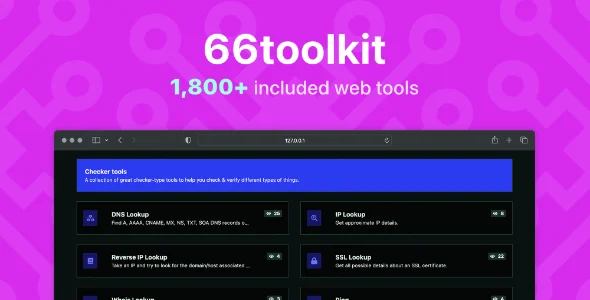
66toolkit Overview & Self-Hosted Web Tools Platform Architecture
66toolkit is a self-hosted PHP 8.x and MySQL 8.x web utilities platform, engineered for agencies and development teams to deploy a searchable catalogue of 2,900+ online tools without building each utility from scratch. The codebase removes the operational bottleneck of assembling image converters, data transformation utilities, SEO analyzers, and developer instruments individually by shipping them as a categorized, database-driven system that installs and reaches a runnable state in under five minutes. Within production delivery workflows it operates as a monetizable tools portal: internal teams run it for daily operations, while service businesses can expose user accounts, metered plans, and checkout flows to external customers.
Technical Specifications & Deployment Matrix
| Engineering Metric | Deployment Specification |
|---|---|
| Base Technology / Framework | PHP 8.x application core with MySQL 8.x persistence; JavaScript JS, HTML, CSS, Sass, SQL, and Layered PNG assets included |
| Runtime / Language Requirements | PHP 8.x server runtime with MySQL 8.x; verified rendering in Firefox, Safari, Opera, Chrome, and Edge |
| Data Exchange / Communication Protocols | REST API for designated platform endpoints; webhook dispatch to external receivers on events such as registrations and payments; SMTP for transactional email |
| Front-End / Engine Dependencies | Vanilla JavaScript with CSS/Sass theming; dark mode theme included; full RTL stylesheet support |
| Database / Persistence Footprint | MySQL schema storing users, tools, submissions, ratings, blog content, and statistics; exportable as CSV, JSON, or PDF |
Tool Orchestration Engine & Execution Pipeline
Inbound requests are routed to dedicated per-tool controllers that render category pages, validate submissions, and write view and usage counters back to the MySQL layer. The router resolves a clean SEO-friendly URL, loads the tool’s multilingual content record, executes the utility logic, and persists the submission so the last-submissions feed can regenerate indexable links dynamically. Sitemap generation and Schema.org structured data are produced automatically as content changes, keeping the crawlable surface synchronized with the database state. Engagement signals—view counts, submission counts, and user ratings—feed the popular and similar tools widgets, which the template layer renders through one of two selectable widget themes.
Architectural & Functional Highlights
- REST API and webhook layer: designated endpoints expose platform data to external consumers, while webhook listeners push payloads to configured receivers during events such as new registrations or completed payments.
- Authentication stack: social logins via Google, Facebook, Twitter, Microsoft, and Discord, optional two-factor authentication, four captcha providers (Turnstile, self-hosted basic, reCAPTCHA v2, hCaptcha), and Single Sign-On across AltumCode installations.
- Abuse prevention: a spam detection layer rate-limits login, registration, lost-password, and activation-resend attempts, while blacklisted email-domain and country rules block abusive signups at the perimeter.
- Monetization engine: twenty payment gateways including Stripe, PayPal, Razorpay, Mollie, Paystack, MercadoPago, and Flutterwave; five billing frequencies from monthly to lifetime; trial and free plans; discount and redeemable codes; tax, invoicing, and multi-currency checkout.
- Content operations: a blog system with categories and per-language SEO fields, custom pages and categories, announcement bars, a newsletter module with segmentation, and social sharing across fourteen platforms.
For operators needing visitor-level behavioral analytics beyond the internal statistics module, evaluating a standalone SaaS analytics stack such as SiteSpy offers an independent measurement path without altering the tools codebase.
Production Implementation & Operational Resilience
Deployment targets a standard LAMP-style environment: PHP 8.x with MySQL 8.x on shared hosting for low-traffic installs, or a VPS when concurrent submission volume climbs. The installer validates a purchase key and records the website URL and server IP against a verification service, so moving a staging copy to a new domain triggers a revalidation step that should be planned into agency handovers. SMTP credentials must be configured before registration emails, activation links, and newsletter campaigns can dispatch, and admin email notifications are toggled per event.
Several utilities depend on third-party endpoints—the image optimizer calls resmush.it, text-to-speech calls the Google API, the website hosting checker queries ip-api.com, and the safe URL checker queries Google Safe Browsing—so an upstream provider outage degrades only those specific tools while the remainder of the platform keeps serving requests. A background cleanup routine detects and removes fake, inactive, or aged accounts, keeping the users table lean without manual SQL intervention. Data portability is preserved through CSV, JSON, and PDF exports, and white-labeling can be granted per plan so clients apply their own logo, favicon, and title. Header and footer ad slots plus an integrated cookie-consent notice round out monetization and compliance surfaces. Agencies operating billing-centric SaaS products in other verticals can study the parallel recurring-payment architecture demonstrated by FinanceLend SaaS – Loan Management Solution as a separate implementation pattern.
Frequently Asked Questions
Does 66toolkit render right-to-left language layouts without custom CSS?
Yes. RTL support ships with the multilingual system, and every interface string is translatable from the admin panel. Optional AI-assisted translation routes through the paid OpenAI API, while user-generated content sits outside the translation layer.
Can customers pay through local payment gateways and currencies?
Yes. Twenty gateways operate under the extended distribution tier, including Stripe, PayPal, Razorpay, Mollie, Paystack, MercadoPago, and Flutterwave, each supporting multi-currency checkout with one-time or recurring billing across five plan frequencies.
Do all 2,900+ tools execute entirely on the local server?
No. Image optimization (resmush.it), text-to-speech (Google API), website hosting checks (ip-api.com), and safe URL verification (Google Safe Browsing) rely on external APIs. If an upstream provider fails, those specific tools stop while the rest stay operational.
Is administrative impersonation of user accounts supported?
Yes. The user management module lets admins create, update, ban, or delete accounts, manage API keys per user, and impersonate an account directly for debugging, alongside Single Sign-On switching between separate AltumCode installations.