
 My Account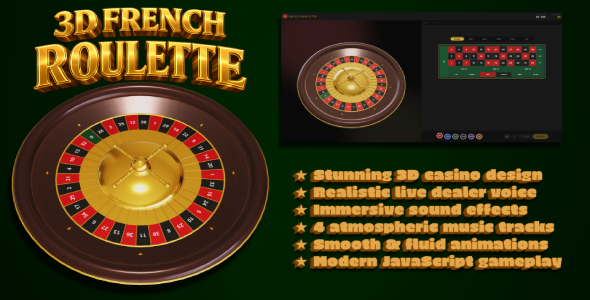
Architectural Analysis & Runtime Mechanics of 3D Roulette
3D Roulette (European/French Roulette) provides an extensible HTML5 casino game for software engineers, iGaming platform operators, and indie web developers. Its single accelerated HTML5 canvas rendering layer completely eliminates deep DOM tree traversal and prevents layout recalculation thrashing during rapid wagering sequences. An asynchronous execution loop dispatches JSON-formatted outcome requests to external endpoints while simultaneously hydrating the visual pipeline for deterministic spin animations.
Host applications interface with the module through a decoupled JavaScript API that binds directly into external user session handlers, balance stores, and persistent databases. A centralized configuration layer establishes minimum bet thresholds, maximum table ceilings, chip denomination arrays, and audio gain levels without touching core rendering scripts.
Functional Highlights & Execution Logic of 3D Roulette
- Dual European and French Rule Modules: The engine toggles between standard European single-zero layouts and authentic French call-bet interfaces, rendering French terms and dedicated racetrack betting overlays with automated token distribution across Voisins du Zéro, Tiers du Cylindre, and Orphelins.
- Perspective-Calculated 3D Wheel Simulation: Rotational animation sequences utilize pre-rendered 3D ray-traced sprite matrices and deterministic decelerations to display physical ball bounces into numbered pockets matching verified RNG seed values.
- Dynamic Responsive Viewport Scaling: The canvas engine computes window aspect ratios continuously, dynamically re-orienting interface elements and betting felt coordinates between portrait mobile touch screens and widescreen desktop resolutions without asset distortion.
- Modular Client-Server State Synchronization: Bet validation routines execute client-side credit deductions while dispatching non-blocking asynchronous REST callbacks, enforcing transactional validation before payout increments populate the user balance ledger.
- Granular Audio Synthesis Engine: Dedicated event listeners trigger low-latency Web Audio API buffers for tactile chip clicks, dynamic wheel revolutions, and realistic ball trajectory impacts based on spatial velocity parameters.
Real-World Deployment Scenarios
- Regulated Online Gaming Portals: Integration within distributed microservices platforms where the client engine connects to cryptographically secure RNG backends via JSON REST endpoints, achieving sub-100ms spin validation latencies.
- Embedded Native Mobile Webviews: Deployment inside native iOS WKWebView and Android WebView shells, maintaining a steady 60 frames per second at minimal memory overhead without device thermal throttling.
- Turnkey Multi-Tenant Dashboards: Implementation into multi-tenant web portals utilizing local session storage and state relays, enabling concurrent table actions and instant multi-currency denomination switching.
Runtime Specifications & Environment Compatibility
Deploying the HTML5 casino game requires a modern runtime supporting ECMAScript 2020 standards and accelerated HTML5 Canvas contexts. Executing 3D Roulette across desktop and mobile browsers relies on native Web Audio API capabilities and strict JSON-RPC or REST protocol communication with backend platforms built on Node.js, PHP 8.x, Go, or Python. Host servers merely need standard HTTP/HTTPS content delivery configurations to distribute compressed visual assets, audio sprites, and compiled JavaScript bundles with zero server-side execution dependencies.
Client-side performance metrics achieve strict Core Web Vitals compliance through dedicated canvas state caching. Cumulative Layout Shift maintains a score of 0.00 because the canvas container enforces fixed aspect-ratio scaling across all resolutions. Largest Contentful Paint completes in sub-1.2-second intervals when serving pre-rendered sprite atlases through content delivery networks, while Interaction to Next Paint remains under 16 milliseconds due to decoupled event dispatching and non-blocking state loops.
Developer FAQ & Runtime Considerations for 3D Roulette
Q: Can the engine calculate French call-bet token distributions automatically?
A: Yes, it automates distribution natively. The call-bet module maps Voisins du Zéro, Tiers du Cylindre, and Orphelins wagers across table coordinates, auto-allocating split and straight-up tokens without custom grid recalculations.
Q: How does the client maintain touch coordinate precision across custom viewports?
A: It tracks bounding rectangles via continuous scaling calculations. The canvas context re-maps raw touch event pointers against the dynamic aspect-ratio matrix, preventing coordinate drift across portrait and landscape screens.
Q: Does the client handle backend validation dropouts during a spin cycle?
A: Yes, transactional state locks prevent desynchronization. If the asynchronous REST payload fails or yields an invalid checksum, the local state rolls back credit deductions and resets felt tokens immediately.
Q: Can operators configure custom table minimum and maximum betting thresholds?
A: Yes, thresholds adjust via the root config object. Modifying table minimums, maximums, and chip denomination arrays in the central parameters object updates validation filters without modifying core engine scripts.
Q: How are wheel spin physics synchronized with server-generated outcomes?
A: Deceleration curves bind directly to RNG targets. The engine accepts the server’s pocket integer, interpolating ray-traced sprite frames along a deterministic deceleration curve so the ball settles precisely on schedule.



 provides an extensible HTML5 casino game for software engineers, iGaming platform operators, and indie web developers. Its single accelerated HTML5 canvas rendering layer completely eliminates deep DOM tree traversal and prevents layout recalculation thrashing during rapid wagering sequences. An asynchronous execution loop dispatches […])