Blueberry – eCommerce React NextJs Template
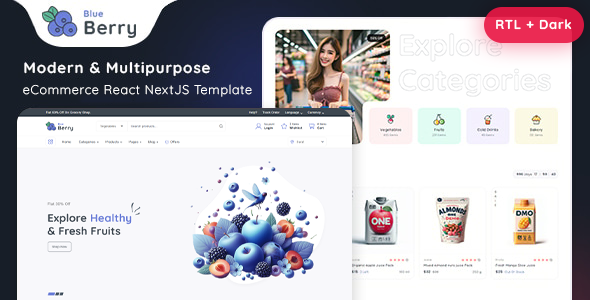
Architectural Analysis & Runtime Mechanics of Blueberry
Blueberry – eCommerce React NextJs Template provides a React eCommerce template engineered for frontend developers, digital agency architects, and headless commerce engineers to build modular retail storefronts. The component layout tree minimizes DOM node depth by rendering static page structures through React Server Components and unnested CSS Grid containers, eliminating unnecessary client-side JavaScript execution overhead. Asynchronous data hydration leverages Next.js static site generation paired with incremental revalidation, streaming product catalog data through React Suspense boundaries without blocking the main browser thread.
Modular components connect to external commerce engines via decoupled TypeScript interfaces and custom React hooks, allowing seamless integration with headless Shopify, Medusa, or custom RESTful backends. A centralized application configuration layer governs API gateway routing URLs, currency display formatting, catalog pagination counts, and promotional notification triggers without requiring core component source code modifications.
Core Engineering Capabilities & Features in Blueberry
- Faceted Catalog Taxonomy Filter: The product browsing view evaluates category, brand, and rating parameters using memoized client-side state hooks, updating catalog grids and URL query strings without triggering full page reloads.
- Interactive Product Variant Swatch Pipeline: The product inspection interface binds color chips and sizing selectors to local component state, asynchronously updating image gallery thumbnails and stock availability indicators within sub-16 millisecond frame budgets.
- Sliding Order Basket Drawer: The persistent shopping container module toggles off-screen overlays via GPU-accelerated CSS transforms, recalculating item subtotals and quantity adjustments locally before synchronizing with backend session stores.
- Asynchronous Quick-View Modal Subsystem: Triggering product preview actions mounts lightweight modal overlays via React Portals, lazy-loading secondary image assets and variation options while preserving background scroll positions.
Practical Production Implementations
- High-Volume Grocery and Supermarket Web Presence: Retail supermarket chains deploy the static build across edge delivery networks, handling high-concurrency inventory searches with sub-second Time to First Byte during peak delivery hours.
- Multi-Brand Fashion Retail Flagship: Apparel merchants implement the dynamic variant swatch modules and sliding order drawers, maintaining fluid 60 FPS scrolling and zero layout shift across mobile viewports.
- Headless Electronics Commercial Platform: Consumer electronics distributors connect the template views to microservices backends, presenting dense technical specification tables and stock trackers without client-side hydration delays.
Runtime Specifications & Environment Compatibility
Blueberry compiles under modern Node.js 18.x and 20.x LTS runtimes, utilizing the Next.js App Router framework alongside React and TypeScript. Production builds generate statically optimized HTML pages and tree-shaken JavaScript bundles, consistently achieving Largest Contentful Paint benchmarks under 1.0 second and maintaining a zero Cumulative Layout Shift score across standardized Lighthouse performance audits.
The presentation layer exhibits complete cross-browser rendering parity across modern Chromium, WebKit, and Gecko browser engines without vendor prefix dependencies. Operating as an extensible React eCommerce template, the frontend infrastructure deploys smoothly to serverless edge platforms including Vercel, Netlify, and Cloudflare Pages while communicating with external commerce APIs through standard JSON payloads.
Frequently Asked Questions
Does the template include pre-configured backend database servers?
No, the codebase operates strictly as a decoupled frontend React application, providing typed mock datasets and API integration hooks designed to connect with external commerce backends or headless microservices cleanly.
How does the sliding basket drawer manage state persistence across page navigation?
Client-side state stores synchronize order basket mutations directly to local browser storage, automatically restoring selected item quantities and calculated subtotal figures during client route transitions without requiring remote server roundtrips.
Can developers customize the global theme typography and color tokens?
Yes, global variables defined in the central styling configuration file govern primary brand colors, typography scales, and container spacing increments, updating all UI components uniformly across desktop and mobile views reliably.
How does image rendering prevent layout shifts during catalog browsing?
The next/image framework enforces predetermined container aspect ratios and serves modern responsive image formats dynamically, allocating layout dimensions before asset rendering begins to completely eliminate cumulative layout shift across mobile viewports.
Can individual product detail pages be statically generated at build time?
Yes, Next.js dynamic routing functions generate static product detail pages using generateStaticParams, serving pre-rendered HTML content while updating stock availability asynchronously via client-side state hooks or incremental static regeneration routines.
-
3 July 2025 LatestSeptember 23, 2026