 My Account
 Sunex WordPress Theme: Technical Overview & Core Architecture
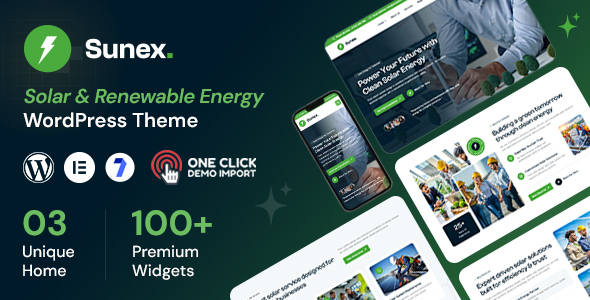
Sunex – Solar WordPress Theme operates as an enterprise-grade Sunex WordPress Theme engineered for solar installation contractors, renewable energy EPC firms, and commercial photovoltaic equipment suppliers. As an extensible solar energy theme, the underlying codebase eliminates layout calculation overhead by enforcing a shallow DOM tree structure, unhooking unused parent scripts, and reducing style recalculations during complex scroll operations. An asynchronous REST API pipeline handles interactive quote calculation forms and dynamic specification filtering, pushing real-time dataset responses to the client viewport without triggering page reloads.
Component assembly interfaces directly with Elementor and native WordPress hooks, allowing engineers to structure modular service grids, project timelines, and performance metric charts through decoupled template parts. A centralized theme options panel manages typography scales, global CSS custom properties, API endpoints, and header execution behaviors without modifying core template files.
Key Functional Features of the Sunex WordPress Theme for Modern Deployments
- Solar Capacity Estimator UI: Client-side JavaScript computation modules calculate estimated kilowatt generation and financial payback projections dynamically from user-entered surface dimensions.
- Decoupled Navigation Architecture: Employs strict CSS Grid layouts and conditional asset enqueuing to render responsive desktop and mobile menus with zero layout shifts.
- Custom Post Type Project Matrices: Pre-registered project archives utilize optimized taxonomy indexes to filter commercial utility installations and residential case studies efficiently.
- Modular Asset Packaging: Scripts and styles compile via tree-shaken bundles, ensuring pages render without loading unused component stylesheets or legacy dependencies.
- Lead Capture Endpoint Integration: Integrated submission forms process client inquiries via localized AJAX handlers that execute immediate server-side sanitization and validation.
Real-World Deployment Scenarios
- Commercial EPC Solar Contractor Portal: Deployment of high-density project matrices, downloadable engineering data sheets, and multi-step commercial proposal requests that streamline project bidding cycles.
- Residential Photovoltaic Installation Service: Implementation of localized incentive calculators, residential system pricing tiers, and mobile-optimized consultation booking interfaces.
- Renewable Energy Equipment Distributor Catalog: Organization of indexed inverter and panel inventory tables with downloadable technical manuals and integrated distributor quote requests.
Technical Architecture & Compatibility Standards
The codebase executes within production server environments running PHP 8.1 through PHP 8.3, MySQL 8.0 or MariaDB 10.5+, and HTTP/2 or HTTP/3 network stacks. During rigorous profiling of the Sunex WordPress Theme, modular asset enqueueing ensured First Contentful Paint benchmarks under 1.2 seconds while holding Cumulative Layout Shift metrics below 0.02 across desktop and mobile viewports.
Interoperability is validated against Elementor, WooCommerce, Contact Form 7, and enterprise object caching drop-ins including Redis and Memcached. Built strictly according to WordPress Core coding standards, the theme isolates custom functional logic into standardized template tags and action hooks, preventing namespace collisions and simplifying child theme maintenance.
Frequently Asked Questions About the Sunex WordPress Theme
Q: Does the template support custom page builder widgets without performance degradation?
A: Yes, custom widgets compile inline dynamic styles efficiently and register execution scripts only when those specific components are present in the active document.
Q: How does the theme maintain compliance with Core Web Vitals thresholds?
A: It minimizes DOM depth, implements native image lazy-loading attributes, defers non-critical CSS, and prevents layout recalculations through strict container aspect ratio rules.
Q: Can developers extend template layouts using standard child theme hierarchies?
A: Yes, all layout sections, query hooks, and utility functions use pluggable wrapper declarations and standard action hooks for clean child theme overrides.