
 My Account
 Xyqo: Technical Overview & Core Architecture
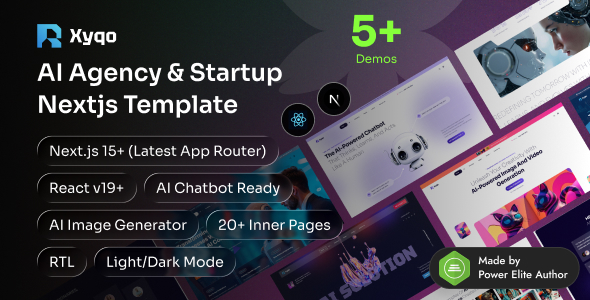
Xyqo – AI Agency & Startup React Next.js Template functions as a modular frontend application framework, serving AI agencies, technology startups, and digital service providers. The internal architecture leverages React’s virtual DOM and Next.js’s static site generation (SSG) capabilities, minimizing DOM re-renders and reducing structural overhead during content-heavy page interactions. Data flow employs Next.js API routes for backend integration and `getServerSideProps` for pre-rendering, ensuring UI states update dynamically with server-fetched data without requiring full page reloads.
Component assembly integrates with the Next.js page routing system, enabling the construction of modular layouts using reusable React components across distinct application views. The codebase utilizes `.env` files and `next.config.js` for centralized configuration, managing API endpoints, image optimization settings, content security policies, and environment-specific variables without modifying core application source. The Xyqo – AI Agency & Startup React Next.js Template ensures a scalable foundation for growing businesses through these configurable parameters.
Key Functional Features of Xyqo for Modern Deployments
- Responsive Layout System: The template implements a CSS Grid and Flexbox-based responsive layout, rendering pixel-perfect content across desktop, tablet, and mobile breakpoints without media query overrides. This ensures consistent UI presentation on devices with varying viewport dimensions.
- Server-Side Rendering (SSR) & Static Site Generation (SSG): The AI Agency & Startup React Next.js Template integrates Next.js’s data fetching methods, including `getServerSideProps` for dynamic, per-request content and `getStaticProps` for pre-building pages, optimizing initial load times and improving SEO indexability.
- Optimized Image Delivery: The Next.js Image component handles automatic image optimization, including lazy loading, responsive sizing, and conversion to modern formats like WebP, reducing image payload sizes and improving perceived page load speed.
- TypeScript Integration: The entire codebase is written in TypeScript, providing static type checking, improved code maintainability, and reduced runtime errors by enforcing type consistency during development.
- Modular Component Library: A collection of pre-built React components, such as navigation bars, hero sections, and feature cards, facilitates rapid UI assembly and ensures design consistency across different application sections.
Real-World Deployment Scenarios
- AI Solution Showcase Platform: A startup specializing in machine learning algorithms deploys the template to create a public-facing website, showcasing their AI services, case studies, and team profiles with optimized content delivery. This results in faster content indexing by search engines and improved user engagement metrics.
- Digital Agency Portfolio: A design and development agency uses the template to build their online portfolio, presenting client projects and service offerings through a performance-optimized and visually consistent interface. This enhances client perception of technical proficiency and professional branding.
- SaaS Product Launch Page: A new Software-as-a-Service (SaaS) product leverages the Xyqo AI Agency & Startup React Next.js Template for its launch page, providing information on features, pricing, and a call-to-action with rapid loading and responsive design. This supports efficient lead generation and conversion tracking.
Technical Architecture & Compatibility Standards
The codebase operates on Node.js environments version 18.0 or higher, leveraging React 18 and Next.js 14 for core application logic and rendering. It strictly adheres to ECMAScript 2022 standards and utilizes TypeScript 5.x for robust type safety. This ensures forward compatibility with modern JavaScript ecosystems and development toolchains.
Performance benchmarks target a Largest Contentful Paint (LCP) under 2.5 seconds and a Cumulative Layout Shift (CLS) below 0.1, facilitated by Next.js’s built-in optimizations like image and font optimization, and code splitting. The template maintains interoperability with standard RESTful APIs for data fetching and integrates with common analytics platforms through environment variables.
Frequently Asked Questions About Xyqo
Q: Does the template support dynamic content updates from external data sources?
A: The template supports dynamic content updates using Next.js data fetching methods like `getServerSideProps` for server-side rendering or `getStaticProps` with revalidation for static content, connecting to any RESTful API endpoint.
Q: Can the template’s visual design be customized without modifying core React components?
A: The template’s visual design is primarily controlled through CSS modules and Tailwind CSS utility classes, enabling extensive styling adjustments by modifying configuration files and stylesheet variables without altering core component logic.
Q: What are the minimum system requirements for deploying this Next.js template?
A: Deploying this Next.js template requires a server environment supporting Node.js version 18.0 or higher, with access to a package manager like npm or yarn for dependency installation and build processes.





 capabilities, minimizing DOM re-renders and reducing structural overhead during content-heavy page […])