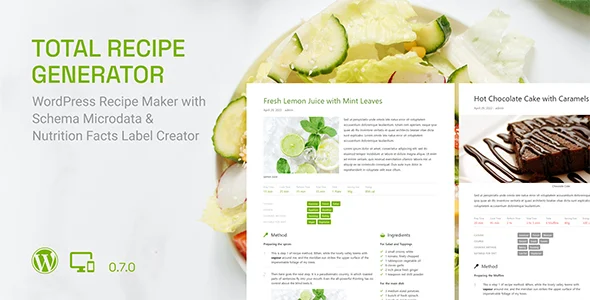
Total Recipe Generator – WordPress Recipe Maker with Schema and Nutrition Facts (Gutenberg Block)
Core Engineering & Architecture of Total Recipe Generator
Total Recipe Generator – WordPress Recipe Maker with Schema and Nutrition Facts (Gutenberg Block) operates as a native React-based block component engineered for food bloggers, culinary educators, and commercial test kitchens. The internal architecture minimizes database overhead by serializing structural recipe parameters directly into standard post content attributes, completely bypassing external custom tables and high-latency database queries. Client-side state mutations process interactive unit conversions and serving calculations instantly in the browser execution thread without requiring asynchronous HTTP requests or server-side DOM re-renders.
Component assembly directly binds to the core block editor registry, constructing modular sections for preparation steps, ingredient groups, and nutritional tables within a flat DOM layout. The block inspector panel governs configuration parameters, allowing editorial teams to manage ISO-8601 preparation durations, schema yield properties, nutritional reference intakes, and media asset associations without directly editing templates or writing custom inline styles.
Key Functional Features of Total Recipe Generator for Modern Deployments
- Automated JSON-LD Schema Generation: The engine formats recipe data into standard Schema.org Recipe specifications upon post save, populating accurate metadata nodes for Google Search rich cards and nutrition snippets without requiring third-party schema plugins.
- Dynamic Serving Scaler: Native mathematical calculation scripts intercept user input on frontend quantity selectors, recalculating fractional and decimal ingredient quantities via client-side JavaScript without altering base database metrics.
- Granular Nutrition Facts Module: Formatted layout components display complete caloric, macronutrient, and micronutrient profiles that align visually with standard FDA nutrition label layouts while mapping directly to structured data values.
- Zero-Dependency Print Layout Engine: Integrated media print CSS queries strip peripheral layout components, sidebars, and navigational elements, sending a clean, monochromatic layout directly to local print drivers.
- Nested Sub-Block Step Management: Multi-tier execution logic groups preparation directions into distinct phases, providing dedicated sub-nodes for step-by-step images, instructional videos, and equipment checklists.
Production Use Cases & Applications
- High-Volume Editorial Food Publishing: Digital food publications utilize the WordPress recipe maker to publish structured editorial workflows, ensuring that every published recipe contains valid JSON-LD schemas that pass Google Rich Results tests instantly.
- Instructional Culinary Academy Platforms: Educational portals deploy the block system to standardize recipe technical sheets for remote culinary students, maintaining consistent instructional layouts and precise metric-to-imperial ingredient ratios.
- Commercial Food Brand Test Kitchens: Brand content repositories use the structured interface to cross-link sponsored culinary items within ingredient fields, displaying accurate nutritional labels to comply with commercial packaging standards.
Technical Specifications & Ecosystem Support
Operating environments require PHP 7.4 or higher, with full native validation on PHP 8.1 and 8.2 configurations running modern WordPress core versions. The block rendering mechanism strictly outputs semantic HTML5 elements wrapped in minimal CSS classes, keeping Largest Contentful Paint (LCP) and Cumulative Layout Shift (CLS) well within Core Web Vitals thresholds. The front-end styling layer avoids external CSS frameworks, delivering minified stylesheets that execute in under 15 kilobytes.
Integration testing ensures comprehensive interoperability with leading edge-caching engines, reverse proxies, and object-caching layers like Redis and Memcached. Because the Total Recipe Generator stores parsed data within standard post content, server-side caching mechanisms serve static HTML snapshots with zero runtime database degradation, ensuring full compatibility with headless and standard WordPress theme environments.
Frequently Asked Questions
Does the block output standard Schema.org structured data automatically?
Yes, the plugin injects valid JSON-LD markup directly into the head or content perimeter of the post upon publication, adhering strictly to Google guidelines for recipe rich results.
Can users scale ingredient measurements dynamically on cached static pages?
Frontend ingredient scaling executes entirely via client-side JavaScript, allowing visitors to multiply or divide recipe servings instantly even when pages are served from full-page static cache layers.
Does this WordPress recipe maker add heavy external JavaScript frameworks to the frontend?
No external libraries or large dependencies are enqueued on the frontend, which keeps page weight minimal and maintains high performance scores across mobile rendering devices.