
 My Account
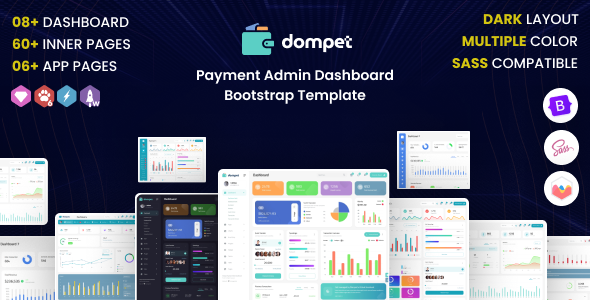
Dompet Dashboard: UI Component Architecture & State Pipeline
Dompet – Payment Admin Dashboard Bootstrap Template is a front-end framework engineered for fintech engineers, payment gateway operators, and banking analytics administrators to operate the Dompet Dashboard. The underlying codebase leverages Bootstrap 5 utility classes and optimized CSS Grid layouts to prevent nested DOM cascades and reduce rendering overhead during real-time ledger updates. Interactive data elements hook directly into Apexcharts and Chart.js instances, re-rendering vector nodes through asynchronous event listeners without triggering full document reflows.
Component modules integrate into modern asset bundling pipelines like Vite or Webpack via modular SCSS architecture, decoupling visual utility tokens from underlying tabular markup. Developers configure global layout states, color token mappings, typography scales, and dark-light mode preferences directly through centralized SCSS variable manifests without rewriting core component source code.
Core Transactional Toolsets & Component Systems in Dompet Dashboard
- Dual-Theme Dynamic Switching: Runtime CSS variables toggle document root attributes between light and dark palettes instantly, bypassing theme stylesheet re-fetches and eliminating white-screen flicker.
- Real-Time Financial Visualizations: Embedded Apexcharts and Chart.js configurations map incoming JSON transaction payloads onto responsive SVG and Canvas layers with sub-millisecond redraw latency.
- High-Density Data Tables: Pre-configured data tables implement column sorting, instant regex filtering, and asynchronous pagination hooks to process dense transaction histories without browser thread lock.
- Modular Authentication Views: Dedicated markup structures for registration, multi-factor login, password recovery, and session lock screens streamline user access state workflows within any backend routing architecture.
Production Deployment Scenarios for Payment Workflows
- Payment Gateway Merchant Portals: Engineering teams deploy the interface as a customer-facing payment admin dashboard to deliver real-time settlement tracking, webhook failure logs, and chargeback dispute management interfaces.
- SaaS Subscription Analytics Consoles: Operations managers utilize the templated metrics cards and recurring revenue charts to track customer lifetime values, churn metrics, and monthly recurring revenue updates across multi-tier accounts.
- Cryptocurrency & Digital Asset Backends: Digital asset exchanges implement the high-contrast data tables and live balance widgets to monitor high-frequency wallet transfers, liquidity pool balances, and user verification queues.
Technical Architecture & Front-End Standards
The payment admin dashboard maintains full W3C semantic compliance across modern Chromium, Gecko, and WebKit rendering engines, achieving first contentful paint benchmarks under 0.8 seconds on standard broadband connections. It eliminates obsolete JavaScript dependencies by operating strictly on native ECMAScript modules and Bootstrap 5 native JavaScript bundles.
Asset compilation workflows execute via Node-Sass or Dart-Sass pipelines, allowing front-end teams to compile minified production CSS bundles under 120 KB. The decoupled HTML5 markup functions out-of-the-box with server-rendered backend frameworks such as Laravel, Django, ASP.NET Core, or client-side single-page applications without template syntax collisions.
Frequently Asked Questions About Dompet Dashboard
Q: Does the template require jQuery to handle interactive UI elements?
A: The Dompet Dashboard operates completely without jQuery dependencies, relying exclusively on vanilla JavaScript and Bootstrap 5 native ECMAScript plugins for dropdowns, modals, and tooltips.
Q: How are data charts connected to live backend APIs?
A: Dynamic data updates occur by passing JSON response objects from your REST or GraphQL endpoints directly into the chart update methods exposed by Apexcharts and Chart.js.
Q: Can the layout be integrated into single-page application frameworks?
A: The layout integrates into React, Vue, or Angular environments by converting the semantic HTML5 structures into component views and bundling the modular SCSS files into the SPA build configuration.




There are no reviews yet.