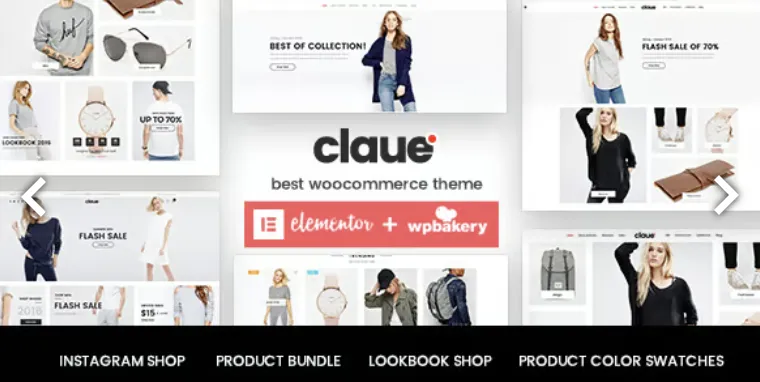
Claue Pro – Clean, Minimal Elementor WooCommerce Theme
Core Storefront Engineering and Modular Architecture of Claue Pro
Claue Pro – Clean, Minimal Elementor WooCommerce Theme is a minimal Elementor WooCommerce theme engineered specifically for independent apparel boutiques, direct-to-consumer lifestyle brands, and high-volume fashion retailers to eliminate storefront visual clutter while sustaining sub-second page rendering speeds. The template codebase separates presentation logic from dynamic store querying by executing modular template overrides across the standard WooCommerce layout hierarchy. Frontend asset delivery relies on conditional script enqueuing, which suppresses unused UI libraries until specific Elementor visual widgets require DOM rendering.
Key Functional Features of Claue Pro for Modern Deployments
- Asynchronous Product Variation Swatches: The architecture shifts variation switching from synchronous page reloads to localized DOM mutations via asynchronous JSON payloads.
- AJAX Off-Canvas Directory Filters: Layered faceted navigation executes via isolated REST endpoints, querying custom taxonomy terms without invalidating transient server-side page caches.
- Deferred Asset Hydration: Claue Pro orchestrates script execution via standard WordPress enqueue priorities, ensuring base CSS renders prior to parsing interactive JavaScript modules.
- Responsive Lookbook Layout Compilers: Dedicated CSS Grid coordinates anchor shoppable visual pins over high-resolution imagery without injecting heavy external slider frameworks.
Production Use Cases & Enterprise Applications
- High-SKU Multi-Variant Apparel Catalogs: The theme manages dense color and size matrices across catalog index archives without multiplying DOM node depths or exhausting PHP memory allocations during faceted filtering.
- Lookbook-Driven Lifestyle Boutiques: Merchandisers deploy shoppable editorial imagery where contextual product tooltips fetch live catalog stock statuses via localized REST queries.
- Mobile-First Luxury Retail Outlets: Dynamic viewport breakpoints reconfigure sticky bottom navigation panels and floating add-to-bag triggers on handheld client devices, minimizing layout shift metrics.
Technical Specifications & Ecosystem Support
Deploying the minimal Elementor WooCommerce theme requires an operational environment configured for persistent object caching and unbuffered query streaming to sustain low time-to-first-byte metrics under concurrent traffic.
| Specification Metric | Production Standard |
|---|---|
| Core Framework Dependencies | WordPress 6.x+, WooCommerce 8.x+, Elementor Core |
| Rendering Architecture | Semantic HTML5, CSS Grid/Flexbox, Native JavaScript Modules |
| Database Query Impact | Standard WooCommerce Taxonomy Caching, Zero Custom Tables |
| Core Web Vitals Readiness | Native Lazy-Loading, Zero Layout Shift Breakpoint Definitions |
Frequently Asked Questions
How does the codebase handle AJAX filtering without corrupting Redis object cache transients?
Product filtering requests query designated WooCommerce WC_Query instances directly through localized endpoint hooks, fetching taxonomy terms independently from persistent page cache keys.
Can third-party visual builder addons override the native styling hooks of the theme?
Developer overrides function cleanly because all template stylesheets adhere to low-specificity CSS rules and provide dedicated WordPress filter hooks prior to final DOM compilation.
How are product variation swatches loaded for items with over one hundred attribute combinations?
The theme defers secondary attribute lookup by loading only default variant data during initial HTML compilation, subsequently querying edge variations via unblocking background fetch requests.