
Zombie Survivor
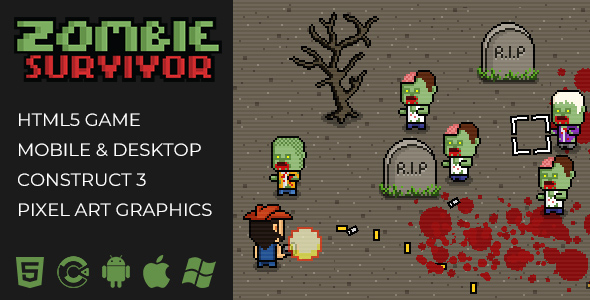
Zombie Survivor: Technical Overview & Architecture
Zombie Survivor is an embeddable HTML5 arcade game plugin built on the Phaser 3 framework, engineered for webmasters looking to boost user engagement and dwell time. The engine renders every entity — player, zombies, projectiles, and pickups — inside a single Canvas 2D element, so a 200-entity wave spawns zero additional DOM nodes and keeps browser layout recalculations at none. Score submissions and leaderboard refreshes run through an AJAX endpoint that writes to the WordPress database and returns updated rankings as JSON, updating the on-screen table without a full page reload.
Integration happens through the WordPress shortcode API, meaning the game mounts into any post, page, or registered widget area with a single shortcode string and no template file edits. The centralized options panel exposes direct numeric controls for player movement speed, zombie health values, spawn rate intervals, wave escalation multipliers, and advertisement slot placement, with each parameter written to the WordPress options table and injected into the Phaser configuration at runtime.
Key Functional Features of Zombie Survivor for Modern Deployments
- Canvas-Based 60 FPS Rendering: All game logic executes within the Phaser 3 fixed-step loop, holding a 60 FPS frame budget on modern desktop browsers and normalizing to device capability on mid-range mobile hardware without frame skipping artifacts.
- Integrated AJAX Leaderboard: Score entries post through an asynchronous WordPress endpoint, ranked results render server-side and inject into the page, and repeat visits show the returning player their standing against the top scores immediately.
- Touch-Optimized Mobile Controls: On-screen directional input activates automatically on viewport detection below the tablet breakpoint, with touch latency normalized through pointer event handling so movement response matches desktop keyboard timing.
- Monetization Slot Architecture: Dedicated pre-game, post-game, and interstitial advertisement positions accept custom embed code from the options panel, letting ad networks load only during non-gameplay states to protect frame timing.
- Deep Gameplay Variable Tuning: Administrators adjust spawn rates, zombie health scaling, player speed, and wave difficulty curves as raw numeric inputs, and every change takes effect on the next session without code modifications.
- Zero-Dependency Shortcode Embedding: The game activates through a single shortcode, requires no external browser plugins, and initializes its assets on first interaction to keep initial page weight low.
Real-World Deployment Scenarios
- Blog Score Contests: An entertainment blog runs a week-long competition where the highest leaderboard entry wins a prize, using the built-in ranked table to verify winners and driving measurable gains in return-visit frequency.
- Membership Site Engagement Layer: A paid community embeds the arcade module into a members-only page, giving subscribers a shared competitive activity that lengthens average session duration across the protected content area.
- Gaming Portal Revenue Channel: A gaming review site deploys the HTML5 arcade game across multiple posts, filling the dedicated ad slots with network embeds and generating impression-based revenue from each gameplay session.
Technical Architecture & Compatibility Standards
The plugin runs on the standard WordPress stack — PHP 8.x with MySQL — and executes all rendering client-side through Phaser 3, which itself relies on native Canvas 2D APIs available in every current version of Chrome, Firefox, Safari, and Edge. Asset loading defers to first user interaction, and because the entire game state lives inside one canvas element, the host page’s Core Web Vitals metrics for layout shift and interaction latency remain governed by the theme rather than the game itself.
On the interoperability side, the shortcode renders cleanly inside Gutenberg blocks, classic editor content, and most page builder text modules, since the game outputs a self-contained container div. The AJAX leaderboard endpoint follows WordPress nonce verification and capability checks, and the options panel stores all configuration in the native options table, meaning caching plugins, CDN layers, and standard security extensions operate alongside it without conflict.
Frequently Asked Questions
Does Zombie Survivor require any external browser plugin to run?
No, the game runs entirely on native Canvas 2D rendering through Phaser 3, so it works in all modern browsers with no Flash, plugins, or additional runtime installations.
Can I adjust zombie spawn rates and player speed without editing code?
Yes, the options panel exposes numeric controls for spawn rates, zombie health, player speed, and wave escalation multipliers, and every value applies to the next session automatically.
Does the leaderboard work on mobile devices?
Yes, score submission and ranked refresh both run through the same AJAX endpoint on touch devices, with the leaderboard table rendering responsively alongside the game canvas.
Can I place advertisements inside the game sessions?
Yes, dedicated pre-game, post-game, and interstitial ad slots accept custom embed code from the admin panel, and they load outside active gameplay to avoid frame timing disruption.
Will embedding the game slow down my page load speed?
No, game assets initialize on first user interaction rather than at page render, so initial page weight and Core Web Vitals measurements stay governed by your theme.